

Published on November 18, 2026
Event Production Network: How to Find, Evaluate, and Coordinate Event Production Partners
Quick Answer
An event production network is a coordinated group of technical specialists, production companies, equipment suppliers, and event professionals who work together to deliver an event. It can provide access to complementary expertise without requiring one company to handle everything. The key to choosing a reliable network is verifying each partner's capabilities, establishing one accountable production lead, and testing how the suppliers work together before the event.
Key Takeaways
- An event production network connects specialists who contribute different skills and resources to an event.
- A functioning network needs more than a directory of suppliers: it requires clear responsibilities, technical compatibility, and central coordination.
- Organizers can choose an integrated production company, independent specialists, or a hybrid arrangement.
- Equipment specifications, crew experience, insurance, venue requirements, and subcontracting arrangements should be verified before signing.
- A shared production schedule and responsibility matrix help prevent communication gaps.
- Backup equipment and alternative arrangements should be tested, not simply listed in a proposal.
- The right production arrangement depends on the event's complexity, location, budget, and required technical services.
What Is an Event Production Network?
An event production network is a group of connected companies and professionals that provides the technical, creative, and operational resources needed to deliver an event.
Rather than relying on one supplier for every requirement, an organizer can bring together specialists with complementary capabilities. One company might coordinate the overall production, while other providers handle audiovisual systems, LED displays, lighting, staging, rigging, power distribution, recording, or on-site technical support.
The important distinction is coordination.
A list of equipment rental companies is not necessarily a production network. Neither is a collection of technicians who have never worked together. A functioning network connects individual suppliers through agreed specifications, schedules, communication procedures, and clearly assigned responsibilities.
For example, imagine a company organizing a corporate conference with a main presentation stage, several breakout rooms, an LED display, professional audio, and a recorded keynote.
Different suppliers might provide the equipment and expertise. However, someone must ensure that the LED processor accepts the required video signals, the audio system supports the presentation format, the installation schedule fits the venue's access window, and every technical operator understands the running order.
Without that coordination, individually capable suppliers can still produce a disorganized event.
The Event Production Network organization
The phrase also has a specific organizational meaning. The North American Event Production Network (EPN) describes itself as an invitation-only alliance of event production companies.
According to its official website, the alliance supports in-person, virtual, and hybrid events. Its published model includes sharing best practices, technology, and labor between member companies. It also describes production services extending from storyboarding and scripting to event logistics, management, livestreaming, simulcasting, and live broadcasting.
EPN's published membership description emphasizes peer review involving equipment quality, technical knowledge, and business practices. These are the organization's own descriptions of its membership model, not independently audited guarantees of individual project performance.
The organization was previously known as the Rental & Staging Network. Its August 5, 2022 rebranding announcement explains that the change reflected a broader move from equipment and staging contributions toward full-service event creation.
For planners interested in this particular alliance, the official website provides a Find an Expert pathway and member-location information.
However, the term can also describe the broader operating model of connecting independent production companies and technical suppliers. Not every production network is a formal association, and hiring several contractors does not automatically create an established network.
This distinction matters when comparing providers: establish whether you are dealing with a membership organization, an integrated production company, or a group of independently contracted suppliers.
Which Specialists Make Up an Event Production Network?
The required specialists depend on the event's format, venue, audience, and technical objectives. A small business presentation may need only a production coordinator, an audio technician, and a display operator. A large conference may require several technical teams working across multiple spaces.
The following roles illustrate how different capabilities can fit together.
Production management and technical direction
Production management connects the event brief to the actual delivery plan.
The production lead coordinates suppliers, technical requirements, installation schedules, rehearsals, and operational decisions. A technical director oversees the technical design and integration of the systems involved.
These roles are particularly important when several companies are involved because individual suppliers otherwise tend to concentrate on their own deliverables.
The production lead should understand the complete event rather than only one equipment category.
Audio and microphone specialists
Audio professionals provide the systems needed for clear speech, presentations, music, and other event sound.
Depending on the event, their responsibilities may include microphone selection, speaker placement, audio mixing, signal routing, monitoring, and troubleshooting.
The production plan should also establish how audio connects with video systems, recording equipment, and any remote broadcast arrangements.
Video, projection, and LED display providers
Visual production specialists support presentation screens, cameras, projection systems, video processing, and LED displays.
Their work may involve screen configuration, content playback, signal distribution, presentation switching, and technical operation.
For an event using a large LED wall, the team needs to confirm display dimensions, resolution, content formats, processor compatibility, viewing conditions, and installation requirements.
A specialist display provider can contribute an important part of the production without necessarily providing the complete event management or technical direction service.
For example, Event Smart Technology's LED screen rental services represent a specialist display requirement that may need to be coordinated with the wider production team.
Lighting, staging, and rigging professionals
Lighting specialists design and operate the lighting needed for presentations, performances, audience visibility, and visual effects.
Staging contractors provide platforms, stage structures, and related infrastructure. Rigging specialists handle the appropriate installation of suspended equipment and structures within the venue's technical and safety requirements.
These services need coordination with venue personnel and other contractors. Ceiling heights, access routes, loading limits, installation windows, and approved rigging arrangements should be confirmed before equipment arrives.
Power, communications, and technical support
Production systems depend on suitable power distribution and reliable communication between operators.
Depending on the event, specialists may need to coordinate electrical distribution, cable routes, equipment connections, technical communications, and backup arrangements.
The team should establish who verifies the available power, who manages connections, and who responds to a technical failure.
Recording and streaming professionals
Some events also need cameras, recording systems, livestreaming, remote presenters, or online audience access.
These requirements introduce additional technical responsibilities, including video capture, encoding, internet connectivity, broadcast monitoring, recording storage, and content delivery.
Not every audiovisual supplier operates streaming platforms or manages remote participants. Those responsibilities should be confirmed separately rather than assumed from a general production-services description.
Should You Use One Production Company or a Network of Specialists?
There are three practical approaches to organizing event production. None is automatically the best choice for every event.
| Decision factor | One integrated provider | Independent specialists | Hybrid production network |
|---|---|---|---|
| Coordination | Primarily managed within one company | Organizer coordinates several suppliers | Central production lead coordinates specialists |
| Accountability | Usually simpler to identify the main provider | May be divided across contracts | Depends on the agreed lead and contracts |
| Specialist expertise | Depends on the provider's in-house capabilities | Can be selected for each requirement | Combines specialist expertise with central oversight |
| Flexibility | Depends on the provider's available services | High flexibility in supplier selection | Flexible while retaining a central plan |
| Technical integration | Managed through the provider's systems and procedures | Requires careful coordination | Requires shared specifications and integration testing |
| Organizer workload | Often lower | Often higher | Moderate, depending on the lead's responsibilities |
| Supplier verification | Focuses on the main provider and its subcontractors | Required for each supplier | Required for each supplier and the coordinating lead |
This is a practical comparison of operating arrangements, not a measured industry-performance study.
Option 1: One integrated production company
An integrated provider handles several production responsibilities under one commercial arrangement.
This can simplify procurement, communication, and scheduling. The organizer has fewer direct supplier relationships to manage.
However, a company advertising a broad service range may still subcontract specialist work. Ask which services are delivered by its own employees, which equipment it owns or controls, and which responsibilities are assigned to outside contractors.
An integrated provider is worth considering when its documented capabilities match the event requirements and its contractual responsibilities are sufficiently clear.
Option 2: Independent specialist suppliers
This approach involves hiring separate companies for individual production requirements.
For example, an organizer might appoint one supplier for LED displays, another for audio, a lighting contractor, and a separate staging company.
The main advantage is the ability to select specialists for specific requirements. This can be useful when the event needs unusual equipment or expertise that one provider does not offer.
The challenge is coordination. Each supplier needs compatible technical specifications, installation schedules, access arrangements, and communication procedures.
The organizer must also understand which company is responsible when a problem involves more than one supplier.
Option 3: A hybrid production network
A hybrid arrangement combines one central production lead with independently selected specialist suppliers.
For example, an organizer could appoint an experienced technical production company to coordinate the project while using specialist contractors for LED displays, staging, lighting, and recording.
The central lead manages the overall production plan, while each specialist remains responsible for its agreed work.
This arrangement can balance specialist expertise and centralized coordination. However, the lead's authority must be documented. The organizer should know whether that company can approve technical changes, direct subcontractors, authorize additional costs, and make decisions during a disruption.
For complex events involving multiple suppliers, this operating model is often worth evaluating first.
How to Build an Event Production Network That Works
Building a reliable network starts with the event requirements, not with a long list of equipment or suppliers.
The following sequence helps organizers develop a practical production arrangement.
1. Define the event and its technical requirements
Start by documenting the event's purpose, format, audience, location, venue, and expected attendance.
Identify what the production needs to achieve. A conference may require clear speech, presentation screens, stage lighting, breakout-room support, and recording. A product launch may place greater emphasis on visual presentation, synchronized playback, and specialized display systems.
Prepare a requirements list that covers:
- Event date, venue, and installation access times.
- Expected attendance and room arrangements.
- Main-stage and breakout-room requirements.
- Audio, video, projection, and LED display needs.
- Lighting, staging, and rigging requirements.
- Power, connectivity, and technical communications.
- Recording, livestreaming, or remote participation where applicable.
- Crew requirements and operating hours.
- Rehearsal, dismantling, and contingency arrangements.
This becomes the common reference document for potential suppliers.
2. Identify the essential specialist capabilities
Separate essential requirements from optional enhancements.
A small meeting may not need a dedicated lighting contractor or separate video production company. A multi-room conference may need specialist teams for each major technical area.
Avoid paying for services that do not contribute to the event's actual objectives.
Also identify requirements that depend on one another. An LED display, for example, may require a compatible processor, playback system, signal distribution, power, installation support, and an operator.
The supplier responsible for each part should understand how its equipment connects with the rest of the production.
3. Find and verify potential suppliers
Potential partners can be found through professional production associations, established local companies, venue recommendations, industry referrals, and specialist supplier directories.
If considering a formal organization such as EPN, use its official member-location and expert-finding resources to identify the relevant route for contacting a production company.
For independent providers, ask for evidence relevant to the exact event requirement.
Useful evidence includes:
- Previous events with comparable technical complexity.
- Equipment specifications and available inventory.
- Names and experience of technical leads.
- Crew availability for the required dates.
- Relevant insurance and safety documentation.
- Venue-specific installation experience where relevant.
- References or project examples that can be independently checked.
- Disclosure of subcontractors and external suppliers.
A professional website or impressive equipment photograph is not proof that a supplier can deliver the complete project.
4. Compare equivalent written quotations
Request quotations against the same technical brief.
A proposal that includes equipment delivery, installation, operation, and dismantling cannot be compared fairly with one that only covers equipment rental.
Ask each supplier to separate the main cost categories:
| Cost category | What to confirm |
|---|---|
| Equipment | Specifications, quantities, rental period, and included accessories |
| Personnel | Crew roles, numbers, working hours, and overtime rates |
| Transport | Delivery, collection, freight, and handling |
| Installation | Setup, testing, technical configuration, and dismantling |
| Venue requirements | Access, approved contractors, and any additional charges |
| Technical support | On-site operation, monitoring, and troubleshooting |
| Backup arrangements | Spare equipment and alternative technical solutions |
| Commercial terms | Deposits, taxes, payment dates, exclusions, and cancellation conditions |
Do not assume that a lower equipment price means a lower total production cost.
5. Assign responsibility and decision authority
Every important task needs a named owner.
For instance, the LED supplier may provide and install the display, but the production lead may approve its placement and integration with the presentation system. The venue may control access and building services, while the organizer approves programme changes.
A responsibility matrix helps prevent assumptions from becoming operational problems.
6. Confirm venue and equipment compatibility
Before installation, verify the technical requirements with the venue and relevant contractors.
Check loading access, equipment routes, ceiling height, rigging restrictions, available power, internet connectivity, storage, installation windows, and any required approvals.
Equipment compatibility deserves equal attention. Two devices can operate correctly on their own but fail to communicate when connected to the complete production system.
Confirm relevant resolutions, signal formats, connectors, control arrangements, power requirements, and audio routing before the event setup begins.
7. Rehearse the complete production
A successful equipment check is not the same as a successful event rehearsal.
Run through the actual programme with the relevant suppliers and operators. Test presentation changes, microphone handovers, video playback, lighting cues, recording, communications, and backup arrangements.
Where applicable, test the complete streaming path from capture through transmission to audience playback.
The rehearsal should also establish who can authorize changes and how the team communicates if the schedule or technical arrangements need to change.
How to Evaluate and Verify Production Network Partners
Supplier evaluation should focus on evidence rather than broad claims about experience, technology, or service quality.
A supplier may have excellent equipment but insufficient staff for the event date. Another may have experienced technicians but lack the particular display or control system required by the production specification.
Both situations need to be identified before contracts are finalized.
Check technical experience and actual inventory
Ask for the equipment specifications relevant to the project, not simply a general catalogue.
For a display installation, for example, check screen dimensions, pixel pitch where relevant, processing capabilities, signal inputs, mounting requirements, and available spare components.
For audio, confirm the proposed system's suitability for the venue and audience. For lighting and staging, establish installation requirements and relevant technical documentation.
The objective is to verify that the supplier can meet the approved specification.
Verify the crew and operational plan
Find out who will actually work on the event.
Ask for the production manager, technical lead, specialist operators, installation crew, and any relevant subcontractors. Confirm availability, responsibilities, working hours, and escalation contacts.
A proposal should not rely on unnamed personnel if their experience or presence is essential to successful delivery.
Review insurance and safety documentation
Production work can involve electrical systems, suspended equipment, temporary structures, heavy components, and busy installation areas.
Ask for the documentation relevant to the supplier's scope and the venue's requirements.
Depending on the work, this may include insurance certificates, equipment documentation, risk assessments, installation procedures, inspection records, and evidence of relevant qualifications.
Requirements vary by location, venue, equipment, and activity. The organizer should confirm applicable obligations with the venue and qualified local professionals rather than assume one supplier's documents cover the entire production.
Understand subcontracting and accountability
Subcontracting is not automatically a disadvantage. A production company may need specialist partners to deliver a particular event.
The concern is whether the arrangement is transparent.
Ask:
- Which services are performed directly by the contracting company?
- Which suppliers or subcontractors will be involved?
- Who supervises their work?
- Who is responsible for installation and technical integration?
- Who resolves disputes or failures between suppliers?
- Which company is contractually responsible for the agreed production delivery?
The answers should be reflected in the written agreement.
Check the commercial terms
Review payment schedules, deposits, cancellation conditions, overtime, additional labor, transport, damage responsibilities, and equipment replacement provisions.
Also establish how changes are approved and charged.
For example, if the organizer requests an additional display or extends the event operating hours, the contract should identify how the revised price and schedule will be approved.
How to Coordinate Suppliers During Production
A production network needs a shared operating structure. Otherwise, each supplier may follow its own schedule and priorities without understanding how its work affects other teams.
The production lead should establish a common production plan that all relevant suppliers can access.
Create a responsibility matrix
A responsibility matrix identifies who supplies, approves, installs, operates, and supports each part of the production.
The following example illustrates how responsibilities might be distributed for a corporate conference.
| Production task | Supplier or responsible party | Required coordination |
|---|---|---|
| Overall production | Central production lead | Master schedule, supplier coordination, escalation |
| Audio system | Audio contractor | Microphones, speakers, mixing, signal checks |
| LED display | Display contractor | Installation, processor, content playback, testing |
| Lighting | Lighting contractor | Design, installation, programming, operating cues |
| Staging | Staging contractor | Platform layout, installation, access, safety coordination |
| Power | Qualified electrical provider or designated technical party | Load requirements, distribution, connections |
| Recording | Video production contractor | Camera positions, recording, storage, delivery |
| Venue access | Venue representative | Loading, installation windows, restrictions, approvals |
| Final programme decisions | Event organizer | Content, presenters, timing, and approved changes |
These are illustrative allocations, not universal contractual or legal assignments. The actual project agreement should identify the responsible parties by name.
Maintain one master production schedule
A master production schedule brings the work of different suppliers together.
It should include:
- Equipment delivery and receiving times.
- Installation start and completion times.
- Venue access and inspection requirements.
- Technical testing and rehearsal periods.
- Presenter and operator call times.
- Programme start and finish times.
- Dismantling and equipment collection.
Use one agreed version of the schedule and identify its owner. Changes should be communicated to all affected parties rather than passed informally between individual suppliers.
Establish communication and escalation procedures
Every supplier should know how to reach the production lead and who can make operational decisions.
A practical communication structure includes:
- A primary production contact.
- Named supplier representatives.
- A shared schedule and current technical specifications.
- An agreed method for urgent communication.
- A process for approving changes.
- A defined escalation route for technical problems.
This is particularly important during live operation, when a delay in communication can affect several parts of the event.
What Makes an Event Production Network Reliable?
Reliability depends on the interaction between people, equipment, procedures, and contingency arrangements.
A network can include experienced specialists and modern technology but still be vulnerable if its equipment has not been integrated or its suppliers do not understand their responsibilities.
Test complete technical connections
Test systems as a complete production rather than checking each device independently.
For example, an LED display should be tested with the actual playback equipment, processor, signal connections, and content formats planned for the event.
Similarly, audio systems should be checked with the microphones, mixing equipment, speakers, and other connected systems that will be used during the programme.
Where recording or streaming is involved, confirm that the full signal path operates as expected.
Prepare practical backup arrangements
A backup plan should address realistic failures.
Depending on the event, this could include:
- Spare microphones and essential cables.
- Backup presentation files and playback equipment.
- Alternative signal paths for critical video systems.
- Replacement equipment for essential components.
- Appropriate backup power arrangements.
- Alternative internet connectivity where necessary.
- A secondary communication method for the production team.
- A named person responsible for initiating each contingency.
Not every event needs every backup. The production lead should identify which failures could materially interrupt the programme and prioritize suitable alternatives.
A backup arrangement is useful only when the required equipment, personnel, and procedures are actually available and tested.
Monitor the production during live operation
The production lead should coordinate suppliers throughout the event.
Technical operators should monitor their assigned systems, while the central lead tracks the overall schedule and coordinates any changes.
The team should know how to report problems, communicate delays, and implement contingency procedures without creating conflicting instructions.
After the event, record any technical problems, unresolved supplier issues, equipment damage, or process improvements that should inform the next production.
Choosing an Event Production Partner in the United States
For US event organizers, the most useful starting point is the event's actual location and production specification.
A company may have suitable equipment but not the necessary local crew or installation capacity for a particular date. Another provider may operate in the right market but need specialist subcontractors to fulfill the complete scope.
Check the following before making a decision:
- Geographic coverage: Can the company serve the exact venue and date?
- Local technical support: Are the required technicians and operators available on-site?
- Equipment capability: Does the proposed inventory meet the technical specification?
- Installation arrangements: Can the company work within the venue's access and setup restrictions?
- Production coordination: Is there a named person responsible for the complete technical plan?
- Contractual accountability: Which company accepts responsibility for the agreed work?
- Contingency arrangements: Are backup equipment and recovery procedures documented?
- Commercial transparency: Are labor, transport, installation, overtime, and exclusions clearly priced?
Where specialist LED and AV services fit
Event Smart Technology is a US event technology provider whose published website identifies LED screen rental and audiovisual services as part of its offering.
Its LED Sphere Rental service describes technical support from preparation through dismantling, LED programming, system redundancy, site-specific planning, on-site collaboration, defined deliverables, and fixed budgeting.
These published capabilities provide an example of the type of technical contribution a specialist display provider may make to a wider event production arrangement.
For organizers, the important point is to understand the boundary between specialist technical services and complete production management.
An LED display provider should be evaluated against the display, installation, programming, and support requirements assigned to it. The organizer should separately establish who manages the remaining suppliers, the complete production schedule, and overall event delivery.
The available published information does not establish that Event Smart Technology is a member of EPN or operates a formal nationwide partner network. It should not be treated as evidence of worldwide coverage or responsibility for every production discipline.
Event Production Network Partner Evaluation Worksheet
A practical evaluation worksheet can help organizers compare suppliers and identify missing responsibilities before committing to a production arrangement.
The following template is designed for procurement and production planning. Its example entries are illustrative, not completed supplier assessments.
| Production requirement | Required supplier or capability | Named supplier and accountable contact | Capability evidence received | Technical compatibility confirmed | Venue and installation confirmed | Insurance and safety documents received | Backup tested | Scope documented | Approval status / action |
|---|---|---|---|---|---|---|---|---|---|
| Audio | Audio system and operator | To be completed | To verify | To verify | To verify | To verify | To verify | To verify | Pending |
| LED/video | Display, processor, playback, operator | To be completed | To verify | To verify | To verify | To verify | To verify | To verify | Pending |
| Lighting | Lighting equipment and technician | To be completed | To verify | To verify | To verify | To verify | To verify | To verify | Pending |
| Staging/rigging | Stage structures and qualified installation | To be completed | To verify | To verify | To verify | To verify | To verify | To verify | Pending |
| Power | Suitable electrical distribution | To be completed | To verify | To verify | To verify | To verify | To verify | To verify | Pending |
| Technical direction | Central technical coordination | To be completed | To verify | To verify | To verify | To verify | To verify | To verify | Pending |
| On-site operation | Production crew and show coordination | To be completed | To verify | To verify | To verify | To verify | To verify | To verify | Pending |
How to use the worksheet
Complete one row for each essential production requirement.
For every row, record the actual supplier, the accountable contact, and the evidence supporting its proposed capability.
Use three practical approval statuses:
- Approved: The capability, responsibility, technical requirements, and relevant documentation have been checked.
- Pending: Evidence or confirmation is still required.
- Not approved: A critical requirement cannot currently be demonstrated or met.
An important production requirement should not receive final approval merely because a supplier says it can provide the service.
For example, a display supplier may confirm that an LED wall is available, but the organizer should still establish whether its processor accepts the planned video signal, whether installation can be completed within the venue's access window, and who will operate the system.
A missing accountable contact, unverified critical connection, or untested essential backup should remain an open action before production begins.
A Sample Inquiry to Send to an Event Production Partner
Once the production requirements are clear, a concise inquiry makes it easier for potential suppliers to provide comparable proposals.
The following is a suggested template, not an official form from EPN or another production organization.
Subject: Event Production Support and Technical Quotation Request
Hello,
We are organizing an event and are looking for production support for the following requirements:
- Event date and location: [Insert details]
- Venue: [Insert venue]
- Expected attendance: [Insert number]
- Event format: [Conference, corporate meeting, product launch, exhibition, or other]
- Production requirements: [Audio, LED display, video, lighting, staging, recording, streaming, etc.]
- Installation and dismantling schedule: [Insert times]
- On-site technical support: [Insert requirements]
- Backup and contingency requirements: [Insert details]
Please provide information about your relevant experience, available equipment, technical team, and ability to deliver the requested services.
We would also appreciate confirmation of:
- Which services you provide directly and which are subcontracted.
- Who will be responsible for coordinating the complete production.
- Your equipment specifications and installation arrangements.
- Your relevant insurance and safety documentation.
- Your backup arrangements and technical escalation procedures.
- The company that will enter into the contract and accept responsibility for the agreed services.
- An itemized quotation covering equipment, labor, transport, installation, operation, dismantling, and additional charges.
Please include any exclusions, payment conditions, and cancellation terms.
Thank you. We look forward to reviewing your proposal.
Frequently Asked Questions
What does event production network mean?
An event production network is a coordinated group of production companies, technical specialists, equipment suppliers, and event professionals who contribute complementary services. It may refer to a formal organization or a broader supplier-coordination model.
What companies or professionals belong in an event production network?
Depending on the event, it may include production managers, technical directors, audiovisual suppliers, LED display providers, lighting and staging contractors, rigging specialists, electricians, recording teams, and on-site technicians.
Is an event production network the same as an event production company?
No. An event production company may deliver several services directly or coordinate subcontractors. A production network involves multiple connected companies or professionals contributing different capabilities. The contractual structure determines who is accountable for the complete delivery.
How do event organizers find production partners?
Organizers can use established industry associations, professional referrals, specialist supplier directories, venue recommendations, and local production companies. Formal alliances such as the North American Event Production Network also provide pathways to identify member companies.
Is it better to hire one production company or several suppliers?
It depends on the event's complexity and required expertise. One integrated provider may simplify coordination, while separate specialists can offer more targeted capabilities. A hybrid arrangement can combine specialist suppliers with one accountable production lead.
Who coordinates an event production network?
A central production lead or technical director typically coordinates the overall schedule, technical specifications, supplier responsibilities, rehearsals, and escalation procedures. The exact authority and contractual responsibilities should be agreed in writing.
How do you check whether production suppliers are reliable?
Review relevant project experience, equipment specifications, crew availability, insurance, safety documentation, references, subcontracting arrangements, and written service scope. Also confirm technical compatibility and test critical backup arrangements.
Can a network include local AV, LED screen, and staging specialists?
Yes. A production arrangement can combine local audiovisual providers, LED display specialists, staging contractors, lighting technicians, and other suppliers. The organizer must confirm local availability, equipment compatibility, installation requirements, and responsibility for coordinating their work.
What is the difference between EPN and a general event production network?
EPN refers to the North American Event Production Network, a specific invitation-only alliance of production companies. A general event production network describes the broader practice of coordinating independent suppliers and specialists. The terms should not be treated as interchangeable in every context.
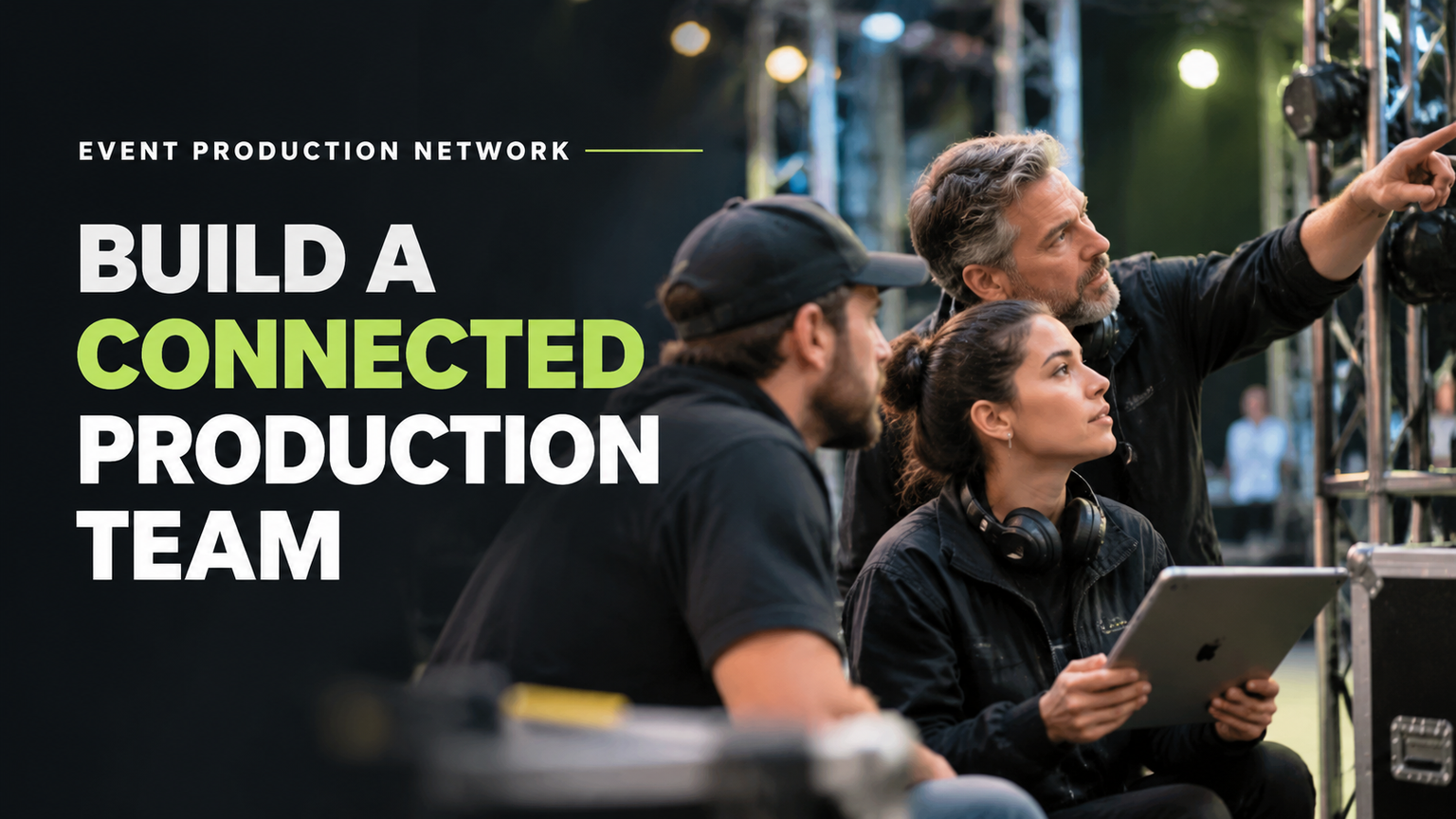
Final Thoughts: Build a Connected Production Team, Not Just a Supplier List
A successful event production network is defined by how well its partners work together, not simply by how many companies participate.
The strongest arrangements combine verified specialist capabilities, compatible technical systems, clear contractual responsibilities, and one coordinated production plan. They also establish practical backup procedures and test the complete setup before the audience arrives.
Start with the event's actual requirements. Decide whether an integrated provider, independent specialists, or a hybrid network offers the most suitable arrangement. Then verify each critical supplier and establish who is accountable for the complete production.
Whether an organizer works with a formal alliance such as EPN or assembles independent local specialists, the same principle applies: every important responsibility needs an owner, every critical connection needs testing, and every essential contingency needs a workable response.
That is what turns an event production network from a collection of suppliers into a coordinated team capable of delivering a well-planned event.