

Published on November 12, 2026
LED Screen Trailer: Sizes, Rental Costs, Features and Event Planning
Quick Answer
An LED screen trailer is a mobile display system with a large LED screen mounted on a transportable trailer, often with a lifting mechanism for outdoor viewing. Before renting or buying one, compare screen visibility, trailer access, deployed footprint, power requirements, weather limits, technical support, and the complete event cost.
Key Takeaways
- An LED screen trailer combines a large display with a mobile transport platform, making it useful for temporary outdoor events.
- Screen dimensions, resolution, pixel pitch, and brightness determine how well the display suits the audience and viewing conditions.
- Some trailers have onboard generators or battery systems; others require external electrical connections.
- Trailer transport dimensions and the space required after deployment are different measurements.
- Published rental examples range considerably and should not be mistaken for a nationwide average.
- Wind restrictions, ground stability, electrical connections, and emergency procedures must be confirmed for the exact model.
- A complete rental quotation should identify delivery, setup, operation, power, audio, and teardown costs.
What Is an LED Screen Trailer and How Does It Work?
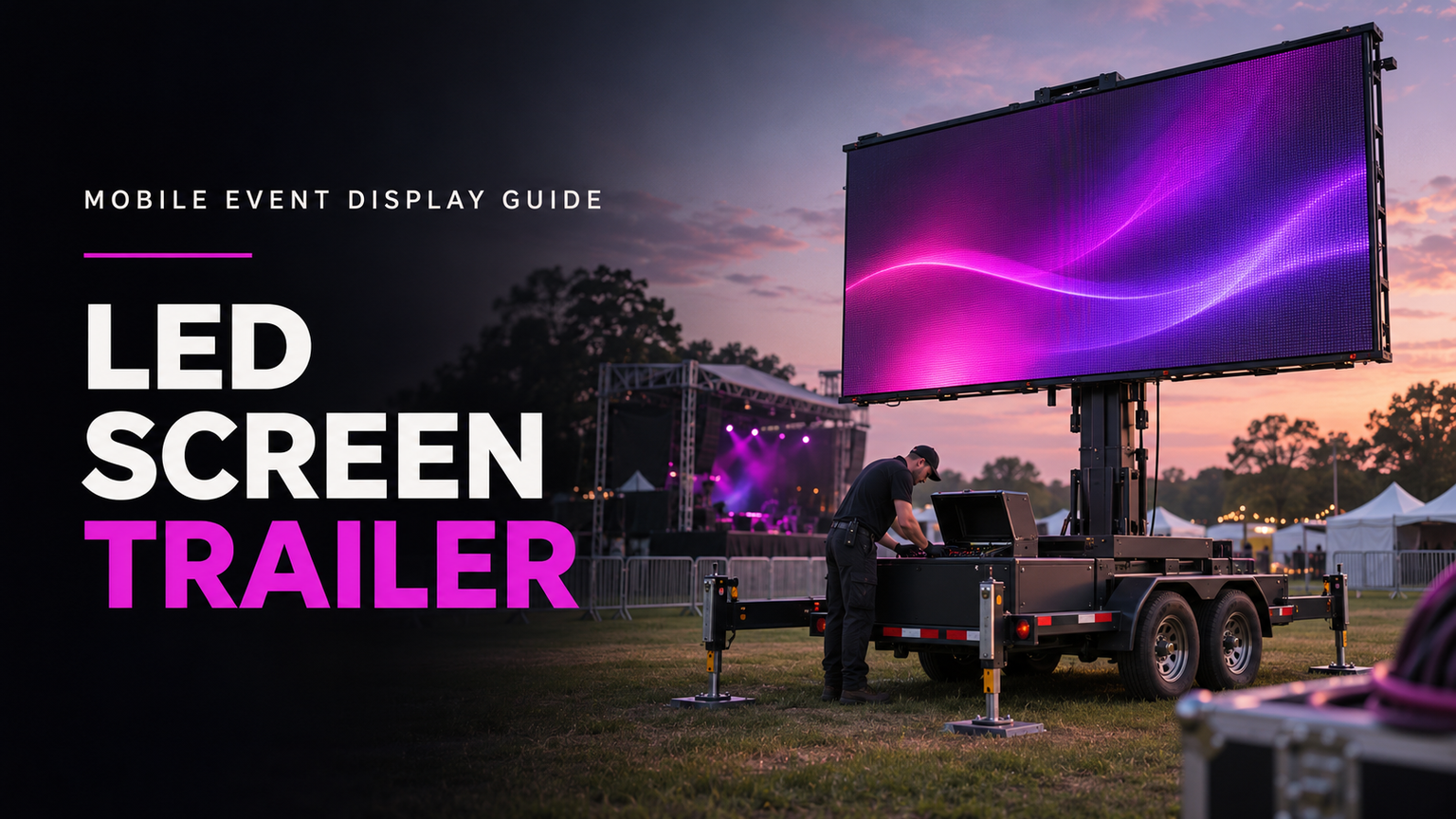
An LED screen trailer is a mobile video display in which a large LED screen is attached to a trailer chassis. The trailer carries the display between locations and provides the supporting structure needed to position it for an event.
Unlike a conventional LED wall that arrives in separate cabinets and requires assembly, a trailer-mounted display is designed around an integrated transport and deployment system.
Depending on the equipment, the system may include:
- Trailer chassis: The transport platform that carries the screen and supporting equipment.
- LED display: The large outdoor screen used for video, presentations, graphics, and live broadcasts.
- Lifting mast: A hydraulic or mechanical system that raises the display into its operating position.
- Rotation mechanism: Available on certain models, allowing the screen to face different audience areas.
- Video processor: Equipment that manages incoming video signals and prepares content for the display.
- Control system: Hardware and software used to operate the screen and manage playback.
- Power equipment: An onboard generator, battery arrangement, external electrical connection, or combination of these.
- Audio equipment: Speakers and associated connections where included in the configuration.
Not every trailer includes all these features. A buyer should request the specification sheet for the exact unit rather than assuming that a feature advertised by one supplier is standard across the market.
For example, Ultimate Outdoor Entertainment advertises a trailer-mounted display measuring 16 by 9 feet, with 7,500-nit brightness and a 4.8-mm pixel pitch. Its published configuration also identifies generator power and operator support. These are specifications for that supplier's equipment, not universal trailer standards.
Similarly, Weedsport Productions describes a 17-by-10-foot mobile display with a lifting height of up to 10 feet and a 360-degree rotation feature.
These examples demonstrate why equipment specifications should be compared individually.
What Screen Sizes and Specifications Should You Compare?
Choosing a mobile LED display involves more than selecting the largest screen available. The display must remain visible to the intended audience, work with the event's content, and fit the physical and environmental conditions of the venue.
Four specifications deserve particular attention: screen dimensions, pixel pitch, resolution, and brightness.
Screen Dimensions and Display Area
Screen dimensions describe the physical width and height of the display. Display area describes the total visible surface.
A larger display can make content easier to see across a wide outdoor viewing area, but its usefulness depends on where the audience stands and how the screen is positioned.
Consider the following questions:
- How wide is the audience viewing area?
- How far away will the nearest and farthest viewers stand?
- Will attendees be seated or moving around?
- Does the screen need to face one audience section or several?
- Will nearby buildings, trees, stages, or other structures obstruct the view?
The supplier should provide the actual display dimensions rather than describing the equipment only as large, giant, or high-definition.
Pixel Pitch and Resolution
Pixel pitch is the distance between the centers of neighboring pixels, measured in millimeters.
It is commonly written as a P-number. For example, P4.8 indicates a pixel pitch of approximately 4.8 millimeters.
A smaller pixel pitch generally provides greater pixel density and finer image detail. This can be valuable when viewers stand relatively close to the screen.
A larger pixel pitch can be suitable for audiences viewing the display from farther away. The correct choice depends on the content and viewing environment, not simply on choosing the smallest available number.
Resolution describes the number of pixels used to create the displayed image. A screen with a large physical surface does not automatically have a high native resolution.
Ask the supplier for both the pixel pitch and native resolution. This is particularly important when displaying presentations, text, graphics, and detailed video.
Brightness and Outdoor Visibility
LED screen brightness is commonly measured in nits. Higher brightness can help a display remain visible in bright surroundings, including outdoor daytime conditions.
However, brightness alone does not establish image quality or guarantee good visibility.
Screen orientation, direct sunlight, ambient lighting, viewing distance, contrast, resolution, and content all affect the result.
For example, Ultimate Outdoor Entertainment publishes 7,500 nits for its mobile trailer, while LiveScreen describes a 13-by-8-foot display with 11,500-nit brightness.
These are individual commercial specifications. They should not be interpreted as a controlled comparison proving that one screen will perform better in every event environment.
A Real Product Specification Example: Creative Technology MS29
A useful way to understand the information buyers should request is to examine a published mobile LED trailer specification sheet.
Creative Technology's October 2025 MS29 product sheet provides the following figures:
| Specification | Published MS29 figure |
|---|---|
| Display area | 16 m² |
| Display dimensions | 5,376 × 2,880 mm |
| Native resolution | 1,008 × 540 pixels |
| Pixel pitch | 5.33 mm |
| Screen rotation | 360° |
| Trailer dimensions | 6,090 × 2,170 × 2,680 mm |
| Ground footprint with outriggers deployed | 3,250 × 4,040 mm |
| Trailer weight | 3,500 kg |
| Electrical connection | 32 A, three-phase, 400 V CEE |
| Maximum power consumption | 25 A |
| Stated maximum operating wind speed | 16 m/s (57.6 km/h) |
Source: Creative Technology MS29 Mobile LED Trailer Product Sheet.
The figures describe one specific product. They are not industry-wide specifications or recommendations for every mobile LED trailer.
Two details are especially important.
First, the deployed support footprint is different from the trailer's transport dimensions. A venue that can accommodate the vehicle may not have enough clear space for its operating configuration.
Second, the sheet identifies a 32 A electrical connection and separately states maximum power consumption of 25 A. These are different specifications and should not be treated as interchangeable electrical requirements.
Mobile LED Trailer vs. Modular LED Video Wall: Which Should You Choose?
Both systems can provide large-format visual displays, but their transport, installation, and configuration requirements differ.
| Decision factor | Mobile LED trailer | Modular LED video wall |
|---|---|---|
| Transport | Display arrives mounted on a trailer | Cabinets and supporting equipment travel separately |
| Deployment | Uses an integrated mobile platform | Requires assembly and suitable support structures |
| Screen configuration | Usually a predefined display format | Can be configured into different dimensions and shapes |
| Site requirements | Vehicle access, parking, level ground, and support footprint | Installation area, structural support, and equipment access |
| Power | May use onboard generation or external electricity | Requires a suitably designed electrical supply |
| Typical applications | Temporary outdoor displays and mobile event coverage | Stage backdrops, custom installations, and indoor or outdoor production |
A mobile trailer can be attractive when an event needs a transportable outdoor display and the site can accommodate the complete trailer system.
A modular LED wall may be more appropriate when the production requires a custom screen shape, a specific stage configuration, or an installation where trailer access is impractical.
Neither option is automatically cheaper or faster in every situation. The total installation requirements and service costs determine the better choice.
For a broader comparison of display formats, installation arrangements, and rental considerations, see Screen Rentals: The Complete Guide to Choosing, Pricing and Booking Display Solutions for Events.
What Events Are Suitable for an LED Screen Trailer?
Mobile LED displays can support events where a large visual presentation needs to reach an audience across an outdoor or temporary venue.
The most useful applications depend on the content, audience arrangement, and available installation space.
Sports Events and Outdoor Watch Parties
Sports organizers can use a trailer-mounted screen to display live broadcasts, replays, and event information.
It can help people follow a match at outdoor viewing parties, community sports gatherings, and temporary fan zones.
Before booking, check the available broadcast source, video connections, audio arrangements, and any applicable content licensing requirements.
Festivals and Fairs
Festivals and fairs often have audiences spread across large outdoor areas.
A mobile screen can display announcements, performance footage, sponsor messages, and other event information.
The organizer should consider crowd movement, sightlines, screen orientation, and whether the proposed location leaves adequate access for vehicles and emergency services.
Concerts and Public Gatherings
A trailer-mounted display can provide live camera feeds and visual content for people who cannot easily see the main stage.
It may also support sponsor messages, program information, and scheduled announcements.
The production team should coordinate the display with the main video system and confirm signal compatibility before the event.
Outdoor Movie Screenings
Outdoor film screenings need a display that suits the viewing area and expected lighting conditions.
A mobile LED screen can be an alternative to a conventional projection setup, particularly where ambient light makes projection less practical.
The organizer should confirm screen visibility, playback equipment, audio coverage, and the permitted content format.
Graduation Ceremonies
Schools, colleges, and universities can use mobile displays for speeches, live camera feeds, announcements, and ceremony information.
This can be useful when a large audience is seated across an outdoor area.
The display position should allow people to see the screen without obstructing important walkways or access routes.
Corporate Events and Product Launches
Corporate organizers can use mobile LED displays for presentations, promotional videos, brand messages, and live production feeds.
The equipment can support temporary outdoor launches, promotional activations, and public-facing presentations.
A suitable package may also require video switching, presentation connections, and an on-site technician.
Commercial examples of mobile display applications are available from US Film Productions and Ultimate Outdoor Entertainment.
These examples demonstrate possible uses, not guaranteed suitability for every venue or event.
How Much Does an LED Screen Trailer Cost to Rent or Buy?
There is no single reliable price for every LED screen trailer. Rental and purchase costs depend on display dimensions, equipment specifications, location, transportation, rental duration, technical support, and included production services.
It is important to distinguish an advertised starting price from a complete event quotation.
Published Rental Price Examples
The following examples illustrate the variation in publicly advertised prices and commercial arrangements.
| Supplier or source | Published price information | Important qualification |
|---|---|---|
| Showtime LED | Rentals starting at $1,000 | Advertised starting price for its Kansas City service area |
| Fullblast Sound survey | Approximately $2,999–$6,500 per day | September 2026 survey of published asking prices for 17-by-10-foot trailers among reviewed operators |
Sources: Showtime LED Mobile LED Screen Rental and Fullblast Sound LED Screen Trailer Rental Rates.
These figures should not be combined into a national average. They describe different commercial offers and are not necessarily equivalent in equipment, travel, staffing, or included services.
Mobile LED Trailer Purchase Examples
Fullblast Sound also lists purchase examples for its mobile LED trailer models:
- MB-15: from $75,000.
- MB-15E: from $90,000.
These are supplier-published asking prices, not independently verified market valuations or universal purchase prices.
Before purchasing, request a detailed equipment specification, warranty information, maintenance requirements, replacement-part availability, and the complete delivery and commissioning arrangements.
What Should a Complete Rental Quotation Include?
A rental quotation should identify the entire service required to operate the screen at the event.
| Cost component | What to confirm |
|---|---|
| Base rental | Included rental hours and dates |
| Transportation | Delivery distance, vehicle arrangements, and collection |
| Setup | Positioning, deployment, and testing |
| Teardown | Lowering, packing, and collection responsibilities |
| Operator | On-site technical personnel and operating hours |
| Power | Generator, fuel, external connection, and backup arrangements |
| Audio | Speakers, microphones, and audio connections |
| Video production | Signal processing, live camera feeds, and video switching |
| Content | Graphics preparation, playback, and format adaptation |
| Overtime | Additional hours and multi-day pricing |
| Insurance and terms | Coverage, cancellation, deposits, and weather provisions |
A lower advertised equipment price may not represent the lower complete event cost. Compare offers using the same rental period, screen configuration, transportation requirements, and technical support scope.
For general display rental configurations and service information, visit Event Smart Technology's LED Screen Rental service. The published service information establishes general LED rental and related production services, but does not establish that the company currently operates a dedicated trailer fleet. Confirm trailer-specific availability directly before making a booking decision.
What Site and Power Requirements Must You Check?
A mobile LED screen trailer needs more than a parking space. The organizer must confirm that the vehicle can reach the location, the equipment can be deployed safely, and the power arrangements can support the event.
Vehicle Access and Turning Space
Start by checking the route from the site entrance to the proposed display location.
Consider:
- Entrance width and height restrictions.
- Vehicle turning clearance.
- Trailer length, width, height, and transport weight.
- Access restrictions, barriers, and temporary road closures.
- Space for positioning and reversing.
- Delivery and collection schedules.
Ask the supplier to confirm the towing and transport arrangements for the exact unit. Do not assume that a trailer suitable for one event location can reach every venue.
Ground Conditions and Deployed Footprint
The surface must be suitable for the trailer and its approved deployment arrangement.
Check whether the location is level and whether the ground can accommodate the equipment's support system.
Some trailers use outriggers or other stabilizing supports. These can substantially increase the area required beyond the vehicle's transport footprint.
The Creative Technology MS29 example illustrates this distinction: its published trailer dimensions are 6,090 × 2,170 mm, while its stated ground footprint with deployed outriggers is 3,250 × 4,040 mm.
Request the manufacturer's deployment diagram and have the supplier assess the proposed location. Do not make structural or ground-bearing assumptions based solely on the screen's physical dimensions.
Electrical Supply and Generator Requirements
Power arrangements vary between mobile LED trailer models.
Some units have onboard generators. Others use battery-assisted systems or require an external electrical supply.
For example, LiveScreen describes a configuration incorporating a 38.4-kWh battery bank and a 5.5-kW Honda generator. The Creative Technology MS29 product sheet instead specifies a 32 A, three-phase, 400 V CEE connection.
These examples demonstrate that power requirements are model-dependent.
Before confirming a booking, request:
- Required electrical connection and voltage.
- Phase and current specifications.
- Maximum power consumption.
- Generator capacity and fuel arrangements, where applicable.
- Battery operating capacity, if included.
- Cable lengths and connection locations.
- Backup-power arrangements.
- Responsibility for supplying and connecting electrical equipment.
Have the electrical arrangements reviewed by appropriately qualified personnel. Do not assume that a standard venue outlet can support the proposed equipment.
Cable Routing and Public Access
Power and signal cables should be routed so that they do not create unnecessary hazards for attendees, staff, or vehicles.
The site plan should identify cable paths, protected crossings, restricted areas, and access routes.
The organizer and supplier should also agree on barriers or exclusion zones around the deployed equipment.
Overhead obstructions, nearby power lines, emergency access, and public movement should be considered before positioning the trailer.
Wind, Weather and Outdoor Safety: What Should You Confirm?
A raised LED screen presents a different operating challenge from a display transported in its lowered position.
Wind, rain, lightning, unstable ground, and other outdoor conditions can affect whether the equipment can safely remain deployed.
The most important rule is to follow the exact manufacturer's operating instructions and approved environmental limits.
Confirm the Manufacturer's Wind Limit
The Creative Technology MS29 product sheet states a maximum operating wind speed of 16 m/s, equivalent to 57.6 km/h, for that specific product configuration.
This figure must not be treated as a universal limit for mobile LED trailers.
Other models may have different approved limits, deployment conditions, monitoring procedures, and emergency requirements.
Ask the supplier to provide the manufacturer's documentation covering:
- Maximum permitted operating wind conditions.
- Required wind monitoring arrangements.
- Restrictions on lifting and lowering the display.
- Emergency lowering procedures.
- Shutdown responsibilities.
- Conditions requiring the event to stop using the equipment.
Do not rely on a generic outdoor rating or a verbal assurance that the trailer can withstand strong winds.
Plan for Severe Weather
The National Weather Service recommends that outdoor event organizers establish weather thresholds, assign monitoring responsibilities, and plan sheltering and evacuation procedures.
Its guidance is available in Weather Considerations for Outdoor Events.
Its Wind Safety guidance also discusses wind-related hazards, including risks involving vehicles towing trailers.
For an LED trailer event, establish:
- Who monitors changing weather conditions.
- Which manufacturer-approved limits trigger operational changes.
- Who has authority to stop screen operation.
- How the display will be lowered or shut down safely.
- Where attendees and staff should go if the event needs to stop.
- How the equipment will be secured after the event.
OSHA's supported scaffolding safety guidance discusses stability, bracing, inspection, and environmental considerations for the scaffolding systems it covers. These principles provide limited general context, but the guidance is not an operating specification for every LED screen trailer.
The supplier's equipment-specific instructions and qualified operational procedures must take priority.
How to Compare LED Screen Trailer Rental Quotes
Once the display and site requirements are understood, compare suppliers using the same information.
A useful quotation should explain not only what equipment is provided but also how the equipment will be transported, deployed, powered, operated, and removed.
Mobile LED Trailer Rental Decision and Site-Readiness Matrix
Use this matrix before accepting a quotation.
| Evaluation area | Buyer's decision | Evidence to request |
|---|---|---|
| Screen suitability | Is the display appropriate for the audience? | Dimensions, pixel pitch, resolution, and brightness |
| Viewing arrangement | Can the screen face the intended audience? | Mast height, rotation capability, and viewing layout |
| Site access | Can the vehicle enter and position safely? | Transport dimensions, weight, and access assessment |
| Ground conditions | Can the system operate on the proposed surface? | Deployment diagram and support-footprint requirements |
| Power | Can the equipment operate for the full event? | Electrical specifications, generator details, and backup plan |
| Weather | Can the display operate within approved conditions? | Manufacturer limits and emergency procedures |
| Technical support | Who manages the equipment during the event? | Named operator and support inclusions |
| Total cost | What will the complete event actually cost? | Itemized quotation, exclusions, and rental terms |
This comparison connects three separate decisions: whether the screen is suitable, whether the site can accommodate it, and whether the supplier's service covers the complete event requirement.
A trailer that performs well technically may still be unsuitable if the vehicle cannot access the site or the required power connection is unavailable.
Request-for-Quote Checklist
Before contacting a supplier, prepare the following information:
- Event date and operating hours.
- Venue name and full address.
- Event type and expected audience size.
- Indoor or outdoor installation location.
- Available vehicle access and parking arrangements.
- Installation surface and ground conditions.
- Approximate audience viewing distance.
- Preferred screen dimensions, if known.
- Required content, including video, presentations, or live camera feeds.
- Audio and microphone requirements.
- Available electrical connections.
- Setup and teardown access times.
- Required on-site technical support.
You do not need to know every technical specification before asking for a quotation. Accurate venue, audience, and event information gives the supplier a useful starting point.
A Practical Request-for-Quote Template
When contacting providers, use a message such as:
We are organizing an outdoor event and would like a quotation for a mobile LED screen trailer.
Event date: [Date]
Venue and address: [Location]
Event type: [Sports event, festival, concert, graduation, or other]
Expected attendance: [Number of attendees]
Approximate viewing distance: [Distance]
Installation surface: [Grass, concrete, asphalt, or other]
Required operating hours: [Hours]
Content requirements: [Live video, presentations, playback, or promotional graphics]
Please provide the screen dimensions, native resolution, pixel pitch, brightness, trailer dimensions, deployed footprint, electrical requirements, and manufacturer weather limits. Please also itemize transportation, setup, teardown, operator support, power, audio, overtime, insurance, and any additional charges.
This gives providers a consistent basis for preparing comparable offers.
Frequently Asked Questions
What is an LED screen trailer?
An LED screen trailer is a mobile display system with a large LED screen mounted on a transportable trailer. Many models include a lifting mechanism and display-control equipment for temporary outdoor events.
How large is a typical mobile LED screen?
There is no single standard size. Published examples include Ultimate Outdoor Entertainment's 16-by-9-foot display and Weedsport Productions' 17-by-10-foot configuration. Available dimensions depend on the supplier and model.
Does an LED screen trailer generate its own electricity?
Some models have onboard generators, battery systems, or hybrid arrangements. Others require an external electrical supply. Always confirm the exact unit's connection specifications and maximum power consumption.
How much does it cost to rent an LED screen trailer?
Published examples include Showtime LED's Kansas City starting price of $1,000 and a September 2026 Fullblast Sound survey reporting approximately $2,999–$6,500 in daily published asking prices for 17-by-10-foot trailers among reviewed operators. These are different commercial offers, not a nationwide average.
Can an LED screen trailer rotate?
Some models have rotating display mechanisms, including the Creative Technology MS29 and the Weedsport Productions example. Rotation is not a universal feature, so confirm the permitted movement and operating procedure for the exact unit.
Can a mobile LED screen be used in rain or wind?
Outdoor suitability depends on the manufacturer's environmental specifications and operating instructions. Confirm rain protection, wind restrictions, monitoring requirements, and emergency procedures before deployment. No generic outdoor rating guarantees safe operation in every weather condition.
How much space does an LED trailer need?
The required space depends on trailer dimensions, access and turning clearance, deployed supports, and operating arrangements. Request both the transport dimensions and the complete deployed footprint, including outriggers where applicable.
Is a mobile LED trailer better than a modular LED wall?
Not in every situation. A mobile trailer can suit temporary outdoor events where an integrated transport and display system is useful. A modular LED wall may be better for custom dimensions, stage installations, or locations where a trailer cannot be positioned conveniently.
Plan the Display Around the Event, Not Just the Screen
Choosing an LED screen trailer is ultimately a question of matching equipment to the event's audience, location, and operating requirements.
Start with the display: confirm dimensions, pixel pitch, resolution, brightness, and viewing distance. Then assess deployment: vehicle access, ground conditions, support footprint, power, and weather restrictions. Finally, examine the service arrangement, including delivery, setup, technical operation, audio, teardown, and the complete rental cost.
A supplier's advertised setup time is not necessarily the total time required to prepare an event. Site access, vehicle positioning, safety checks, content testing, sound checks, and contingency planning also need to be considered.
Event Smart Technology provides general LED screen rental and event display services. Its published service information can help readers explore display configurations and rental support, but trailer-specific inventory and availability should be confirmed directly rather than assumed.
For event organizers comparing mobile displays with other rental arrangements, the wider Event Smart Technology screen rental guide provides additional context.
The best LED screen trailer is not necessarily the largest or brightest model. It is the one that delivers the viewing experience the event needs, fits the site safely, operates within its approved technical limits, and comes with a clearly defined service and pricing agreement.