

Published on November 10, 2026
LED Wall Installation for Events: Venue Readiness, Safety, and Setup Checklist
Quick Answer
A successful LED wall installation involves more than assembling display panels and connecting video cables. For a temporary event installation, organizers must coordinate the display position, supporting structure, venue approvals, floor or rigging capacity, delivery access, electrical supply, video signal, installation schedule, testing, and dismantling. The venue and qualified technical professionals must approve the relevant arrangements before installation begins.
Key Takeaways
- Confirm whether the display will be ground-supported or flown before finalizing the venue layout.
- Obtain site-specific structural and venue approvals rather than assuming existing floors or rigging points are suitable.
- Give the installation team accurate access, loading, and scheduling information.
- Assign responsibility for electrical distribution, video signal, and technical control.
- Inspect and test the complete display before allowing audience access.
- Agree on operational support, contingency arrangements, and dismantling responsibilities in advance.
What Does an LED Wall Installation Involve at an Event?
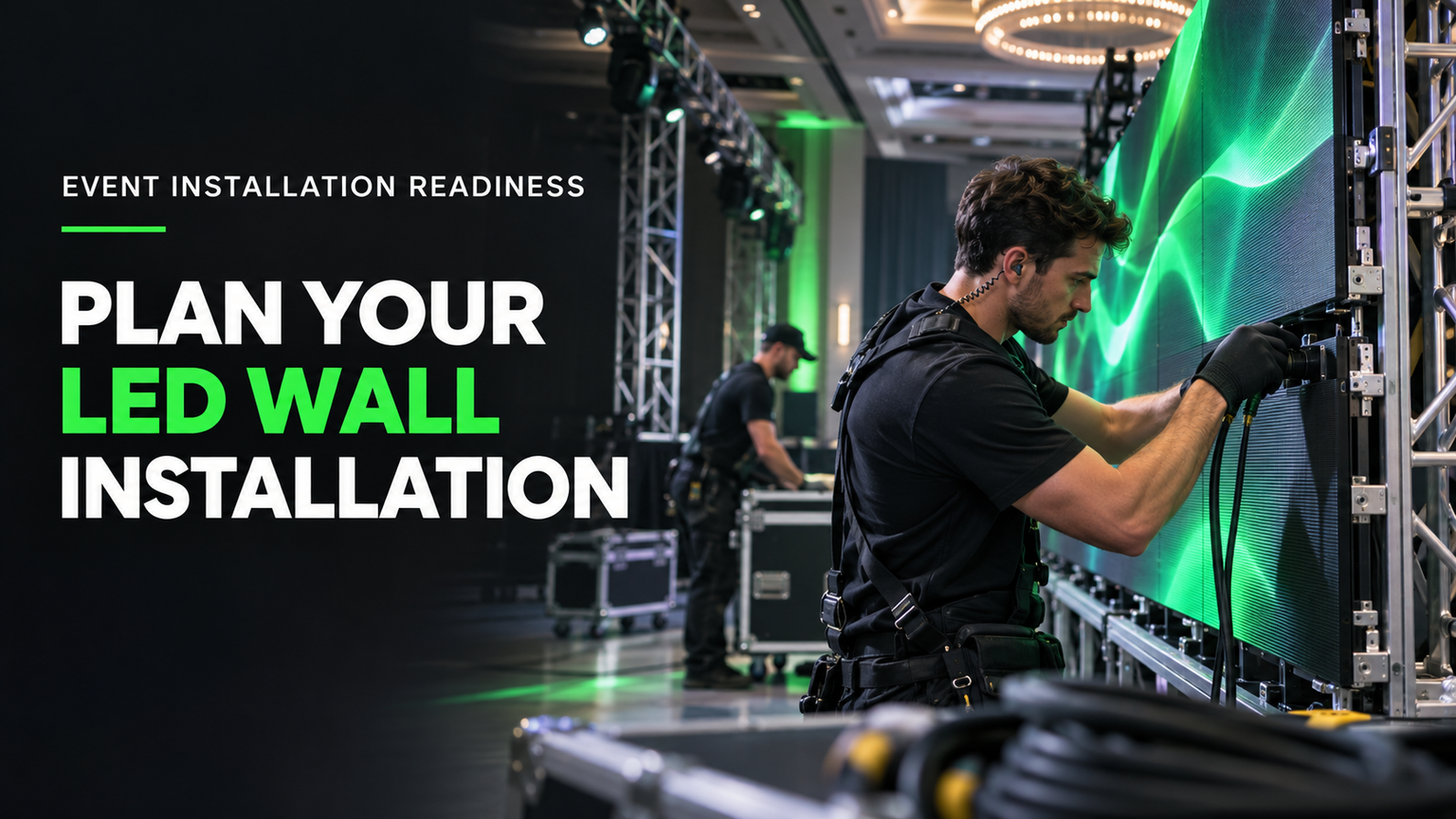
An event LED wall installation is the process of preparing, assembling, supporting, connecting, testing, and operating a large modular LED display for a live event.
It usually involves several connected systems and teams:
- Display equipment: LED cabinets, modules, connection hardware, and the video processing equipment needed to produce the image.
- Supporting structure: A ground-supported frame, approved overhead suspension system, or another suitable mounting arrangement.
- Electrical distribution: An appropriate power supply and distribution arrangement for the selected equipment.
- Video and control: Content sources, signal distribution, processors, control positions, and operator access.
- Installation personnel: Technicians, supervisors, rigging personnel where required, and other qualified contractors.
- Live operation and dismantling: Technical monitoring during the event, followed by controlled removal and load-out.
These elements must work together. A display can arrive at the venue in perfect condition and still be impossible to install safely if the supporting structure, delivery route, electrical arrangements, or required approvals are missing.
Temporary event installations also differ from permanent architectural LED installations. An event display may be assembled for a limited period, supported by temporary structures, and removed after the production. Its planning must account for the complete installation and dismantling lifecycle.
The standard ANSI E1.50-1-2025, Entertainment Technology: Requirements for Temporary Display System Structures, specifically addresses temporary display structures. Its scope includes planning, site preparedness, assembly, erection, suspension, use, and dismantling.
This is an important distinction: the LED panels are only one part of the installation. The structure supporting them is a separate safety consideration.
Which Installation Arrangement Fits the Venue?
Two common arrangements for temporary event LED walls are ground-supported and flown installations. A wall-mounted arrangement may also be appropriate in certain permanent or specially designed applications.
The choice depends on the venue, display configuration, available support, engineering assessment, and production requirements.
| Consideration | Ground-supported installation | Flown installation |
|---|---|---|
| Primary support | Dedicated structure supported from the ground | Approved overhead suspension system |
| Floor space | Requires an allocated footprint and support area | Can reduce the floor-level support footprint |
| Main structural concern | Floor conditions and support configuration | Rigging points, suspended loads, and structural approval |
| Venue coordination | Venue, supplier, and appropriate structural professional | Venue, rigging provider, and appropriate structural professional |
| Access considerations | Clear floor area for assembly and support | Safe overhead access and suitable lifting arrangements |
Ground-supported LED walls
A ground-supported display uses a dedicated structure to support the LED wall from the floor.
This arrangement may be useful when overhead suspension is unavailable, restricted, or unsuitable for the proposed configuration. However, the venue must still confirm that the floor and surrounding installation area can accommodate the complete support arrangement.
The relevant assessment should consider more than the visible display weight. The complete installed configuration, including support components and applicable loads, must be considered by the responsible professionals.
Ask the supplier for the proposed support arrangement and ask the venue who can approve its use in the selected location.
Flown LED walls
A flown display is suspended using an approved rigging or structural support arrangement.
It may suit productions where floor space is limited or where the screen needs to be positioned above the stage. However, an existing ceiling point, truss, or rigging attachment is not automatically suitable for a new display.
The venue and relevant rigging and structural professionals must assess the proposed configuration, including individual attachment-point loads, the overall rigging arrangement, obstructions, access, and applicable safety requirements.
The ANSI ES1.18-2022 Event Safety: Rigging guidance provides relevant guidance on event rigging responsibilities and considerations.
Is one arrangement better?
Not universally. A ground-supported arrangement introduces floor-space and support considerations, while a flown arrangement introduces overhead suspension and rigging approval considerations.
The appropriate method is the one supported by the venue's conditions, the equipment configuration, and the required professional approvals. The event organizer should not make the structural decision based solely on appearance or convenience.
What Should the Venue Confirm Before Installation?
Venue readiness is one of the most important parts of planning an LED wall installation. Confirming these details before delivery helps prevent delays, last-minute layout changes, and unsafe workarounds.
1. Display position and dimensions
Start with the proposed display location.
The event producer and LED supplier should agree on a preliminary layout showing:
- Display position relative to the stage and audience.
- Overall display dimensions.
- Proposed support arrangement.
- Viewing and production-control positions.
- Nearby equipment and stage obstructions.
- Required access for installation and servicing.
The venue should review the proposed layout before the supplier finalizes the installation plan.
Also consider doors, emergency exits, walkways, fire-safety equipment, and audience circulation. The screen and its support structure must not create an unapproved obstruction or interfere with venue operations.
2. Floor conditions and structural capacity
For a ground-supported installation, ask the venue about the relevant floor-loading information and any restrictions affecting the proposed installation area.
For a flown installation, request the applicable rigging information and approval process.
Important details include:
- Available floor-loading documentation.
- Existing structural restrictions.
- Overall rigging capacity.
- Individual rigging-point capacity.
- Ceiling height and overhead obstructions.
- Proposed support locations.
- Relevant engineering and inspection documentation.
The structural professional responsible for the installation must assess the actual configuration. A venue's general capacity information is not automatically approval for every proposed arrangement.
The ANSI E1.50-1-2025 temporary display structure standard is the primary reference to discuss with the installation and structural teams when planning temporary display support.
For entertainment rigging personnel, the Entertainment Technician Certification Program (ETCP) describes its Arena and Theatre rigging credentials. Such qualifications can help demonstrate relevant professional experience, but ETCP certification should not be described as a universal legal requirement. Applicable venue rules and jurisdictional requirements determine the actual qualifications and approvals needed.
3. Delivery route and loading access
A technically approved installation can still encounter problems if the equipment cannot reach the installation area.
Before confirming the delivery schedule, obtain the venue's loading and access information.
Check:
- Loading dock availability and operating hours.
- Delivery vehicle restrictions.
- Door and corridor widths.
- Elevator dimensions and capacity.
- Access restrictions and security procedures.
- Distance between unloading and installation locations.
- Temporary storage arrangements.
- Restrictions on moving equipment through public areas.
The supplier should confirm the transportation and handling requirements for the selected equipment.
Do not assume that equipment can be delivered through the venue's main entrance simply because guests use that entrance.
4. Installation and dismantling windows
Agree on the complete working schedule, not just the delivery time.
The installation team may need separate periods for unloading, positioning, structural assembly, display assembly, electrical and signal connections, testing, rehearsal, and final inspection.
The venue should confirm when these activities can take place and whether other contractors will be working in the same area.
Also agree on the dismantling window. The event may finish before the venue allows equipment removal, or another production activity may affect access.
A written schedule reduces confusion about who can enter the space, when work can begin, and when the area must be cleared.
5. Work-at-height and venue safety rules
Flown installations and other elevated work require appropriate planning and competent personnel.
Ask the venue and responsible contractors to confirm:
- Applicable work-at-height procedures.
- Approved access equipment.
- Relevant personal protective equipment.
- Work-area restrictions.
- Supervision and communication arrangements.
- Emergency and rescue procedures where applicable.
- Required documentation and inspections.
The event producer should ensure that contractors understand the venue's safety requirements before work begins.
How Do You Coordinate Power and Video Signal?
An LED wall requires both suitable electrical arrangements and a reliable video signal. These are separate technical responsibilities and should be coordinated before the installation crew arrives.
Electrical supply and distribution
The electrical requirements depend on the selected display system, its configuration, manufacturer specifications, and applicable installation rules.
Avoid relying on generic online amperage recommendations or assuming that a nearby wall outlet can power the complete system.
Instead, request the equipment's electrical specifications from the supplier and have the responsible electrical contractor or qualified person determine the appropriate supply and distribution arrangement.
Confirm:
- Equipment-specific electrical specifications.
- Maximum connected load and applicable operating requirements.
- Available venue power and approved distribution locations.
- Grounding and electrical protection arrangements.
- Cable routes and protection from damage.
- Responsibility for electrical distribution and final connections.
- Any generator or backup-power arrangements, if applicable.
The distinction between average consumption and maximum connected load matters. Manufacturer guidance from Uniview LED's installation checklist identifies maximum connected load as an important consideration for circuit planning. The actual requirements must be verified against the selected equipment documentation.
For US installations, OSHA's Subpart S Electrical Standard eTool provides information about electrical installation safety, equipment suitability, wiring, grounding, and protection. Its guidance is informational; applicable legal requirements depend on the specific installation and circumstances.
Video signal and control
Power alone does not make an LED wall operational. The production team must also establish how video content reaches the display.
The LED supplier and event AV team should agree on:
- Content source devices.
- Video formats and output connections.
- Signal distribution and routing.
- Video processor location.
- Control position and operator access.
- Cable paths and connection responsibilities.
- Backup or contingency arrangements, where included.
- Rehearsal and content-testing requirements.
A signal-flow drawing can help prevent confusion. It should identify the source, processing equipment, distribution path, display connections, and control position.
For example, if a presentation laptop is located at the production desk but the LED processor is positioned backstage, the team must know how the signal will travel between those locations and who supplies the necessary connections.
Agree on the content format and test the actual source devices before the event. A display that works with a technician's test signal may still encounter problems when the production laptop, presentation software, or live video source is connected.
LED walls should also be coordinated with the wider event production setup. Where relevant, the Event Smart Technology AV services page provides a first-party reference for coordinating screens, video, power, lighting, and rigging-related event AV requirements.
How Should the Installation, Testing, and Handover Work?
A clear installation sequence helps the venue, supplier, and event producer understand when each approval and technical check is needed.
Step 1: Complete the site-readiness review
Before equipment delivery, confirm the approved layout, proposed support arrangement, structural responsibilities, power requirements, signal plan, and access schedule.
Outstanding approvals should be identified rather than left for the installation crew to resolve on arrival.
Step 2: Confirm delivery and access
The venue and production manager should confirm the delivery route, unloading location, access times, equipment movement restrictions, and installation area.
The installation supervisor should ensure the crew understands the approved working area and site-specific rules.
Step 3: Establish the approved supporting structure
The installation team should follow the approved structural arrangement and applicable manufacturer instructions.
Any discrepancy between the approved plan and actual site conditions should be referred to the responsible professionals before work continues.
Do not improvise structural changes to compensate for unexpected venue conditions.
Step 4: Assemble and inspect the display
Qualified installation personnel should assemble the display using the selected system's instructions and approved fixing arrangements.
Inspection should address relevant connections, cabinet alignment, support stability, cable management, and service access.
The exact inspection procedure depends on the equipment and installation design.
Step 5: Complete electrical and signal connections
The responsible electrical personnel should complete the approved electrical arrangements. The video team should then establish the agreed signal and control connections.
Before energization or operation, verify that the required technical checks and approvals have been completed.
Step 6: Test the display and content sources
Testing should cover more than whether the screen lights up.
The technical team should check:
- Image output across the complete display.
- Visible alignment and consistency between sections.
- Content source connections.
- Video processor and signal routing.
- Expected content formats.
- Control and operator access.
- Relevant system warnings or faults.
- Agreed contingency arrangements.
The event producer or production representative should confirm that the intended content displays correctly in the actual event environment.
Step 7: Complete commissioning and acceptance
Commissioning is the process of checking that the installed system operates as intended and is ready for its planned use.
The responsible technician should complete the relevant equipment-specific checks and provide any agreed test or commissioning records.
The production representative should confirm that outstanding problems have been resolved before audience access.
Step 8: Confirm live-operation responsibilities
Before doors open, identify the person responsible for monitoring the LED wall and the person to contact if something goes wrong.
Agree on escalation arrangements for signal loss, display faults, power interruptions, or other operational problems.
Do not assume backup equipment, redundant power, or spare modules are included in a rental package. Confirm what is actually provided.
Step 9: Follow the agreed dismantling plan
After the event, the installation supervisor and production manager should coordinate removal, equipment handling, and load-out.
Follow the approved work sequence and venue access arrangements. Confirm who is responsible for restoring the installation area and completing the final handover.
The FORCE EVENT installation lifecycle guide provides additional general context on preparation, commissioning, live operation, and dismantling.
The LED Wall Installation Readiness and Responsibility Checklist
One of the most useful ways to organize a temporary installation is to connect every technical requirement to a responsible party, supporting evidence, and an approval stage.
The following matrix is designed for event producers, venue managers, and LED suppliers to use during planning meetings.
| Installation checkpoint | Main responsible party | Evidence to request | Approval gate |
|---|---|---|---|
| Display position and dimensions | Event producer and LED supplier | Approved venue layout and display drawing | Before final configuration |
| Delivery and access | Venue and production manager | Loading instructions, route, and access times | Before delivery scheduling |
| Ground support | Supplier and appropriate structural professional | Support design and site-specific load assessment | Before installation |
| Flown support | Venue, rigging provider, and structural professional | Approved rigging plan and relevant load information | Before rigging work |
| Floor capacity | Venue and structural professional | Relevant floor-loading information and approved configuration | Before ground-supported installation |
| Electrical supply | Electrical contractor and LED supplier | Equipment specifications and approved distribution plan | Before energization |
| Signal and control | Video supplier and event AV team | Source list, signal-flow drawing, processor, and control plan | Before rehearsal |
| Work-at-height arrangements | Employer, venue, and qualified personnel | Relevant work plan, access, and rescue arrangements | Before elevated work |
| System assembly | Installation supervisor and crew | Manufacturer instructions and inspection records | During installation |
| Commissioning | Video technician and production representative | Test results, image inspection, and source verification | Before audience access |
| Operational support | Production manager and LED technician | Contact and escalation arrangements | Before doors open |
| Dismantling | Production manager and installation supervisor | Agreed load-out sequence and access window | Before event completion |
This matrix is an editorial planning aid. It does not replace engineering calculations, manufacturer instructions, applicable legal requirements, or formal venue approval.
Copy-ready pre-installation information request
Event organizers can use the following request when contacting a venue and LED installation provider.
Subject: LED Wall Installation – Venue Readiness and Technical Information
Hello,
We are planning a temporary LED wall installation for an upcoming event and would like to confirm the venue's technical requirements before finalizing the installation arrangements.
Could you please provide or confirm the following information?
- Current venue floor plan and stage layout.
- Proposed display location and permitted installation dimensions.
- Whether ground-supported or flown arrangements are permitted.
- Available floor-loading information and relevant rigging documentation.
- Structural approval requirements and the responsible approval contact.
- Loading dock details, delivery routes, door dimensions, and elevator restrictions.
- Permitted installation, testing, rehearsal, and dismantling windows.
- Available electrical supply information and the responsible electrical contact.
- Venue requirements for cable routing, grounding, and electrical distribution.
- Content sources, video-control position, and relevant AV connection requirements.
- Work-at-height procedures and other venue safety requirements.
- Required commissioning records and pre-event inspection procedures.
- Operational support and emergency escalation arrangements.
- Any additional venue-specific labor, insurance, access, or contractor requirements.
Please also identify the relevant contacts for venue operations, structural or rigging approval, electrical coordination, and event production.
Thank you.
This request should be adapted to the actual venue, equipment, and event requirements. It is intended to collect information, not to authorize work before the necessary approvals are obtained.
Common LED Wall Installation Mistakes to Avoid
Even experienced event teams can encounter preventable problems when technical responsibilities are not agreed upon early enough.
Assuming existing truss is suitable
A venue may have truss or overhead rigging points, but their existence does not prove that they can support the proposed LED wall configuration.
Obtain the relevant documentation and approval for the actual installation.
Booking equipment before checking venue access
The equipment may be available, but the loading dock, elevator, delivery vehicle, or installation route may not accommodate the planned delivery.
Check access before confirming the final schedule.
Treating power as a minor detail
An available outlet does not establish that the supply is appropriate for the complete display system.
Obtain the manufacturer's electrical information and coordinate the distribution plan with the responsible electrical professional.
Leaving signal coordination until rehearsal
Late discovery of incompatible source connections or missing signal routes can affect the production schedule.
Agree on the signal-flow plan and test the actual source devices before the event.
Failing to assign approval responsibilities
The LED supplier, venue, rigging provider, electrical contractor, and event producer may each have different responsibilities.
A written responsibility matrix helps identify who supplies information, who approves the work, and who confirms readiness.
Forgetting dismantling requirements
The event's end time is not necessarily the equipment removal time.
Confirm the venue's load-out window, access restrictions, and responsible supervisor before the event begins.
Working With an LED Wall Rental and AV Provider
For a temporary event, a professional LED rental provider can coordinate equipment delivery, display setup, and technical operation. However, the exact responsibilities included in a rental arrangement should be established in writing.
Before confirming a provider, ask:
- Who prepares the proposed installation layout?
- Who supplies the supporting structure?
- Who obtains or coordinates structural and venue approvals?
- Who is responsible for electrical distribution?
- Who provides video processing and signal distribution?
- Who supervises assembly and testing?
- Is an onsite LED technician included?
- What backup equipment or contingency arrangements are available?
- Who coordinates dismantling and load-out?
Event Smart Technology describes its LED display rental and installation offering on its LED Screen Rental page. Its published service information is a relevant starting point for discussing delivery, setup, and onsite technical support.
The company also describes technical coordination and site-specific planning on its homepage, including project preparation and coordination with production teams. These published service descriptions should not be interpreted as proof that every engineering approval, electrical service, or contingency arrangement is included in every project.
Request a project-specific scope of work that identifies the actual equipment, installation responsibilities, approvals, schedule, technical support, and exclusions.
Frequently Asked Questions
How long does an event LED wall installation take?
There is no reliable universal installation duration. The schedule depends on display configuration, supporting structure, venue access, crew requirements, electrical and signal coordination, testing, and approval arrangements. Ask the supplier for a project-specific installation and dismantling schedule.
Is a venue's existing truss automatically suitable for an LED wall?
No. Existing truss or rigging points must be assessed for the proposed loads and configuration. Obtain the required venue approval and relevant structural or rigging documentation before suspension work begins.
Who approves a flown LED wall installation?
The approval process depends on the venue, jurisdiction, and installation arrangement. The venue, rigging provider, and appropriate structural professionals should establish the required assessment, documentation, and authorization before work starts.
Does an LED wall require a dedicated power supply?
The electrical arrangement depends on the selected LED system and its maximum connected load. The supplier should provide the equipment specifications, and the responsible electrical professional should determine the appropriate supply and distribution. Do not rely on generic circuit recommendations.
What information should an LED wall installer receive before arriving?
Provide the venue floor plan, proposed display position, dimensions, support arrangement, relevant structural information, delivery instructions, access times, electrical details, signal requirements, safety rules, and named project contacts.
What should be tested before guests enter?
Check the complete image output, cabinet alignment, content sources, video processing, signal routing, control position, relevant system faults, and agreed contingency arrangements. Complete the required commissioning and acceptance process before audience access.
Who is responsible for dismantling and load-out?
Responsibility should be agreed in the project scope and production schedule. Typically, the installation supervisor coordinates equipment removal while the production manager and venue coordinate timing, access, and site handover. The actual contractual allocation must be confirmed.
Can an LED wall be installed outdoors?
Outdoor installations require equipment and supporting arrangements suitable for the specific environment. Confirm the manufacturer's operating limitations, environmental protection, structural design, weather restrictions, electrical arrangements, and venue requirements. Indoor equipment should not be assumed suitable for outdoor use.
Final Thoughts: Make the Venue Ready Before the Equipment Arrives
A successful LED wall installation begins long before the first display cabinet reaches the venue. The event producer must coordinate the display location, supporting structure, venue approvals, delivery route, electrical arrangements, video signal, installation sequence, and final acceptance.
The most important step is to make responsibility clear. The venue should know what it must approve, the supplier should know what equipment and technical support it must provide, qualified professionals should handle the relevant structural and electrical decisions, and the production team should know who is responsible for testing and live operation.
Use the installation-readiness matrix and pre-installation information request to identify missing details before load-in. When every approval, technical requirement, and handover responsibility is documented, the installation team has a much clearer path from delivery to a tested, event-ready display.