

Published on November 14, 2026
Mobile LED Screen: How to Choose the Right Display for Your Event
Quick Answer
A mobile LED screen is a digital display designed to be transported and deployed at different locations. It can be trailer-mounted, integrated into a truck, assembled from modular LED cabinets, or supplied as a portable LED poster. The right choice depends on your event, audience viewing distance, transportation access, available space, electrical supply, and installation requirements. Before booking, compare the complete deployed system rather than screen size alone.
Key Takeaways
- Mobile LED screens include four main formats: trailer-mounted, truck-mounted, modular LED walls, and portable LED posters.
- Trailer and truck displays can suit large outdoor audiences, while modular walls offer greater flexibility for custom event stages.
- Pixel pitch, resolution, brightness, and viewing distance influence how clearly an audience can see the display.
- A screen's advertised display area does not represent its complete operating footprint.
- Some mobile displays require external electricity rather than having an integrated generator.
- Weather restrictions, ground conditions, transportation access, and installation requirements must be checked before booking.
- Rental quotations should identify delivery, setup, technical operation, power arrangements, and additional charges.
What Is a Mobile LED Screen?
A mobile LED screen is an electronic display system that can be transported and used at different locations. It uses light-emitting diodes (LEDs) to produce images, video, graphics, and text on a large digital surface.
The important distinction is how the display moves and gets deployed. A mobile LED screen does not have to be mounted on a trailer. Some systems travel as complete vehicles, while others arrive in protective transport cases and are assembled at the venue.
The four common configurations are:
- Trailer-mounted LED screens: Displays attached to towable trailers that can be transported behind suitable vehicles and deployed at event locations.
- Truck-mounted LED screens: Displays integrated into vehicles, allowing the equipment to travel between advertising or event locations.
- Modular mobile LED walls: Individual display cabinets transported separately and assembled into a larger screen at the venue.
- Portable LED posters: Compact, usually portrait-oriented displays designed for exhibitions, entrances, retail environments, and smaller promotional spaces.
These systems solve different transportation and installation problems. A large trailer display might be convenient for a stationary outdoor festival but unsuitable for a venue with restricted vehicle access. A modular wall might fit that venue more easily, although it requires assembly and suitable structural support.
Manufacturers such as Mobiled describe different vehicle-mounted and trailer-based configurations. The broader category also includes modular rental displays and smaller portable screens.
A mobile display should also be distinguished from a conventional fixed digital billboard. A fixed billboard can change its advertising content electronically, but its physical display structure is not mobile.
Which Type of Mobile LED Screen Is Right for Your Event?
The most useful way to compare mobile LED displays is to consider transportation, deployment, audience size, and site restrictions together.
The following matrix is a qualitative decision guide, not a measured performance ranking. Actual suitability depends on the equipment model and event conditions.
Mobile LED Screen Format Comparison
| Decision factor | Trailer-mounted | Truck-mounted | Modular LED wall | Portable LED poster |
|---|---|---|---|---|
| Transportation | Complete towable unit | Integrated vehicle | Protective transport cases | Compact display |
| Large outdoor events | Strong candidate | Strong candidate | Possible with suitable installation | Generally unsuitable |
| Multi-location campaigns | Possible | Strong candidate | Requires repeated assembly | Suitable for smaller promotions |
| Custom screen dimensions | Model-dependent | Vehicle-dependent | Highly flexible | Limited |
| Restricted vehicle access | Can be difficult | Can be difficult | Cases may be easier to transport | Generally easier |
| Installation | Deployment-dependent | Vehicle-system-dependent | Assembly required | Generally simpler |
| Main site consideration | Parking and deployed footprint | Vehicle access and parking | Support structure and assembly area | Floor space and viewing distance |
1. Trailer-Mounted LED Screens
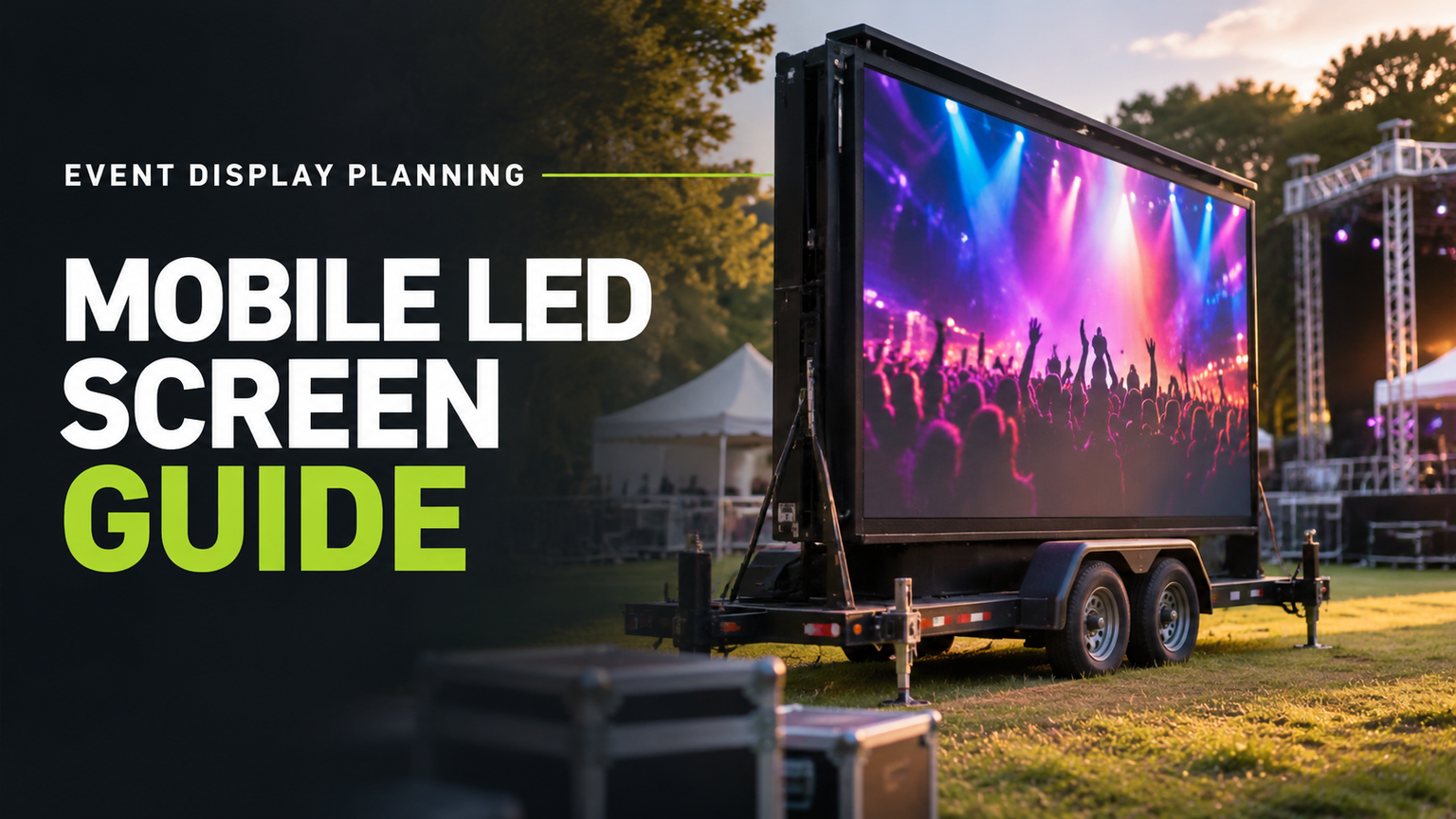
A trailer-mounted LED screen combines a display with a towable transport platform. Depending on its design, the screen may be raised or positioned using a lifting mechanism once the trailer reaches the event site.
This configuration can be useful for:
- Outdoor festivals and public gatherings.
- Sports viewing events.
- Temporary outdoor entertainment venues.
- Community celebrations.
- Single-location promotional events.
Its main advantage is that the display and transportation platform are supplied as one system. This can reduce the need to assemble a large screen from individual cabinets at the venue.
However, a trailer requires suitable access, parking, ground conditions, and room for any deployed supports or stabilizers. The towing vehicle and trailer dimensions must also be compatible with the access route.
A trailer that looks compact while being transported may require considerably more space once the display is deployed.
2. Truck-Mounted LED Screens
A truck-mounted LED screen integrates the display into a vehicle. The vehicle transports the equipment between locations, making this arrangement particularly relevant to promotional campaigns and touring activities.
Potential applications include:
- Mobile promotional campaigns.
- Multi-location advertising events.
- Public information campaigns.
- Touring entertainment programs.
- Temporary demonstrations and product launches.
The main benefit is transportation flexibility between planned locations. However, vehicle dimensions, road access, parking arrangements, operating positions, and local restrictions must be considered.
A truck-mounted display is not automatically suitable for every roadshow. The vehicle must be able to reach and operate safely at each planned location.
3. Modular Mobile LED Walls
A modular LED wall is constructed from individual display cabinets or panels that connect to form a larger screen.
The equipment can be transported in protective cases and assembled at the destination. This makes it mobile even though it is not mounted on a vehicle or trailer.
Modular LED walls are commonly considered for:
- Concert stages.
- Corporate conferences.
- Trade shows and exhibitions.
- Product launches.
- Temporary presentation environments.
- Indoor and outdoor event installations where suitable equipment and support are available.
Their major advantage is configuration flexibility. A production team can select a suitable width, height, and arrangement based on the venue and audience.
The trade-off is installation complexity. The project may require assembly crews, mounting or ground-support structures, power distribution, video processing, and additional setup time.
If the event requires a conventional professional LED wall rather than a vehicle-mounted system, compare the available configurations through Event Smart Technology's LED screen rental service.
4. Portable LED Posters
Portable LED posters are smaller digital displays, usually designed for vertical placement.
They are suitable for applications such as:
- Exhibition entrances.
- Reception areas.
- Retail promotions.
- Registration desks.
- Product demonstrations.
- Indoor promotional displays.
Their compact size makes transportation and placement simpler than moving a large trailer or constructing a video wall.
However, they are not normally a substitute for a large outdoor event screen. Their display area and viewing coverage are more limited.
Choose this format when the objective is to communicate information in a relatively small space rather than provide a large viewing surface for a distant audience.
Which Events Benefit from a Mobile LED Display?
Mobile LED displays can support several types of temporary events. The most appropriate configuration depends on whether the equipment will remain in one location, travel between locations, or become part of a custom stage installation.
Outdoor Festivals and Public Gatherings
Outdoor festivals may need large displays for presentations, event information, entertainment content, or live video feeds.
Trailer-mounted displays can be worth considering when the venue has adequate vehicle access, parking, and deployment space. Truck-mounted displays may also suit events requiring transportation between different locations.
For a festival with a custom stage design, a modular LED wall may provide more control over the screen's shape and placement.
Concerts and Entertainment Events
Concerts often require displays that integrate with the stage, lighting, camera feeds, and production equipment.
A modular LED wall can be appropriate when the production requires a specific stage configuration. A mobile trailer screen may serve a different purpose, such as providing an additional viewing surface for an outdoor audience.
The important question is whether the display must integrate into the main stage production or operate as a separate screen.
Sports and Community Events
Outdoor sports screenings and community events may benefit from a display that can be transported and deployed temporarily.
Before selecting equipment, consider:
- The size of the viewing audience.
- The nearest and farthest viewing positions.
- Whether the screen needs to show live footage.
- Available power infrastructure.
- Vehicle access and ground conditions.
- Weather and operating restrictions.
For live sports coverage, confirm that the display's video processor accepts the required camera or broadcast signal.
Corporate Activations and Product Launches
Businesses may use temporary LED displays for product demonstrations, event presentations, brand activations, and promotional experiences.
A modular display may be preferable when the screen needs to fit a particular exhibition stand or stage. A portable poster can be more practical for reception and information areas.
The choice should follow the physical requirements of the event rather than an assumption that a larger display is always more effective.
Promotional Roadshows
Roadshows involve moving equipment between multiple locations over a campaign period.
A truck-mounted screen may be worth investigating when the display must travel as part of a vehicle-based operation. A trailer-mounted configuration can also be considered when the same display is deployed at several suitable sites.
A modular LED wall is another option, but repeated assembly and dismantling can add operational work.
For a multi-stop campaign, calculate the complete transportation and deployment requirements at every location, not just the first venue.
How Do You Choose Screen Size and Pixel Pitch?
Screen dimensions are important, but they do not tell the whole story. The display must also have sufficient resolution and appropriate pixel spacing for the audience's viewing positions.
Understand Pixel Pitch
Pixel pitch is the distance between the centers of two neighboring pixels on an LED display. It is measured in millimeters and commonly expressed using a P-number.
For example:
- P2.5 represents approximately 2.5 mm between adjacent pixel centers.
- P3.07 represents approximately 3.07 mm.
- P4 represents approximately 4 mm.
- P5 represents approximately 5 mm.
A smaller pixel pitch generally provides greater pixel density and finer image detail. This can be useful when viewers stand relatively close to the display.
A larger pixel pitch may be appropriate when viewers are farther away and do not need to see fine details at close range.
Mobiled lists different outdoor display configurations, including P2.5, P3.07, P4, and P5. These are examples of supplier-specific configurations, not universal recommendations for particular event sizes. See its mobile LED display information.
The right specification depends on the actual screen dimensions, content, audience positions, and viewing conditions.
Consider Native Resolution
Native resolution describes the number of pixels available across the display's width and height.
A screen's physical size does not automatically indicate how much image detail it can reproduce. Two displays with similar dimensions may have different native resolutions.
Ask the supplier for both the physical dimensions and native pixel resolution. This is particularly important when displaying presentations, detailed graphics, text, or live video.
Match the Screen to Viewing Distance
Think about where the audience will actually stand or sit.
A display positioned close to visitors at an exhibition may require finer pixel spacing than an outdoor screen viewed from much farther away.
Ask the supplier to evaluate:
- The nearest audience position.
- The farthest expected viewing position.
- The width of the viewing area.
- Whether people will view the screen from the front or from different angles.
- Whether the content includes small text or detailed graphics.
Do not select a screen solely from the expected attendance figure. Two events with 500 attendees can have very different viewing layouts.
Check Brightness and Ambient Lighting
Outdoor displays must be suitable for their expected lighting conditions.
A screen operating in direct daylight faces different viewing conditions from one used after sunset or beneath a covered structure.
Brightness is commonly measured in nits. Higher brightness specifications may be relevant to outdoor applications, but brightness alone does not guarantee good image quality or comfortable viewing.
Resolution, pixel pitch, viewing angle, content design, and ambient light also influence the result.
United Signs publishes brightness specifications of 5,000–6,000 nits for some of its mobile trailer configurations. These figures are supplier-specific examples, not universal requirements for every mobile LED screen. Refer to its mobile LED trailer information.
Ask for the actual equipment specification and confirmation that it is suitable for the intended environment.
What Space, Power and Weather Requirements Should You Check?
This is one of the most important parts of selecting a mobile LED screen. A display can have suitable dimensions and resolution but still be unsuitable for a venue because its complete deployment requirements cannot be accommodated.
Check Transportation and Site Access
Before confirming a trailer or truck-mounted display, establish whether the vehicle can reach the intended operating location.
Check:
- Entrance width and height restrictions.
- Road access and turning space.
- Vehicle and trailer dimensions.
- Parking and unloading arrangements.
- Ground conditions and available operating space.
- Restrictions on delivery and installation times.
- Access for emergency vehicles and other event operations.
For modular displays, check whether the transport cases can reach the installation area and whether there is sufficient room for assembly.
Understand the Difference Between Screen Area and Operating Footprint
The screen's visible area is not the same as the complete area required to operate the equipment.
A trailer-mounted display may need additional clearance for rotation, lifting mechanisms, stabilizers, or outriggers. The deployed footprint can therefore be larger than the trailer's transport dimensions.
A useful manufacturer example comes from Creative Technology's October 2025 MS29 mobile LED trailer technical specification sheet.
| Published specification | MS29 example |
|---|---|
| Display area | 16 m² |
| Display dimensions | 5,376 × 2,880 mm |
| Native resolution | 1,008 × 540 pixels |
| Pixel pitch | 5.33 mm |
| Trailer dimensions | 6,090 × 2,170 × 2,680 mm |
| Trailer weight | 3,500 kg |
| Deployed outrigger footprint | 3,250 × 4,040 mm |
| Rotation clearance from trailer body | 1,700 mm per side |
| External electrical connector | 32 A, three-phase, 400 V CEE |
| Maximum power consumption | 25 A |
| Built-in generator | No |
| Published operating wind limit | 16 m/s |
Source: Creative Technology — MS29 16 sqm Mobile LED Trailer Technical Specifications, October 2025.
This example illustrates an important planning difference. The display itself covers 16 square metres, but the complete installation needs additional ground space, clearance, and external electrical infrastructure.
The published 3,250 × 4,040 mm footprint applies to the deployed outriggers. The separate rotation clearance must also be considered when planning the site.
The figures describe this particular MS29 configuration only. They must not be treated as standard specifications for all mobile LED screens or as evidence of equipment available from a particular rental provider.
Confirm Electrical Requirements
Mobile does not necessarily mean independently powered.
Depending on the system, an LED display may use:
- An external venue electrical connection.
- A separate generator.
- An integrated generator, where the equipment is designed with one.
- Another manufacturer-approved power arrangement.
The MS29 example demonstrates why this must be confirmed. Its published specification identifies a 32 A, three-phase, 400 V CEE connection and states that the trailer has no built-in generator.
Its maximum published power consumption is 25 A.
These figures are not universal electrical requirements. Your supplier should provide the actual equipment's electrical documentation and explain the connection, distribution, and backup arrangements needed for the event.
Do not assume that an ordinary venue socket or an available generator will automatically meet the equipment's requirements.
Check Weather and Wind Restrictions
Outdoor equipment must operate within the manufacturer's stated environmental conditions.
Ask the supplier about:
- Rain and moisture protection.
- Dust and environmental exposure.
- Manufacturer-specified IP rating, where applicable.
- Wind operating limits.
- Ground stability.
- Stabilizer or anchoring arrangements.
- Operating procedures during adverse weather.
IP stands for Ingress Protection. It describes the degree of protection an enclosure provides against the entry of solid objects and water under specified testing conditions.
A product's IP rating is not a blanket guarantee that it can operate safely in every outdoor environment.
The MS29 specification publishes an operating wind limit of 16 m/s, equivalent to 57.6 km/h. This is a model-specific manufacturer figure, not a universal safe wind threshold for mobile LED displays.
The appropriate response to changing weather depends on the manufacturer's instructions and the equipment's configuration. Ask who monitors conditions and who has authority to stop operation or lower the display.
Local regulations may also apply. For example, the 2024 North Carolina Fire Prevention Code, Chapter 31 contains provisions addressing temporary event structures and outdoor assembly conditions in North Carolina.
Its requirements should not automatically be applied to every vehicle-mounted or freestanding LED screen, or treated as nationwide rules. Confirm the applicable requirements with the relevant local authority and event organizer.
Confirm Video Inputs and Playback
A mobile LED screen needs a compatible system for delivering visual content to the display.
For scheduled promotional content, an asynchronous media player may be appropriate. For live camera feeds or stage video, the system may need a compatible video processor and synchronous signal input.
Before booking, confirm:
- Supported video input connections.
- Native display resolution and processor compatibility.
- Playback file formats.
- Live camera or broadcast-feed compatibility.
- Content switching arrangements.
- Who supplies and operates the playback equipment.
- Backup signal and troubleshooting procedures.
The Creative Technology MS29 product sheet identifies 3G-SDI, DVI, and HDMI inputs for that particular system. Do not assume another model supports the same connections.
Should You Rent or Buy a Mobile LED Screen?
The choice between renting and purchasing depends on how frequently the equipment will be used and whether your organization can manage transportation, installation, maintenance, and technical operation.
When Renting Makes Sense
Rental may be appropriate when:
- You need a display for a one-time event.
- Your organization runs occasional festivals or promotional activities.
- You need equipment for a seasonal campaign.
- You do not have suitable storage facilities.
- You prefer to arrange technical support through a service provider.
- You do not want responsibility for maintaining a display fleet.
A rental agreement can bring equipment and services together, but the exact scope must be checked. Do not assume that delivery, setup, operators, generators, or backup equipment are automatically included.
For conventional event display requirements, Event Smart Technology's LED screen rental service provides a relevant starting point for discussing equipment configurations and event rental arrangements. Its verified service information does not, by itself, establish that a particular mobile trailer or truck-mounted model is available.
When Purchasing Makes Sense
Purchasing may be worth evaluating when:
- Your organization uses the equipment frequently.
- You have recurring events or campaigns.
- You can store and transport the display appropriately.
- You have trained personnel for installation and operation.
- You can manage repairs and maintenance.
- Your expected utilization can justify the complete ownership cost.
Ownership involves more than the initial equipment purchase. Include transportation, towing, storage, maintenance, insurance, operators, repairs, replacement parts, and equipment downtime in the financial assessment.
Compare the Complete Cost, Not Just the Display Price
There is no verified nationwide average rental or purchase price for mobile LED screens established by the available research. Costs vary according to the display configuration, screen dimensions, rental period, transportation, site requirements, technical support, and operating conditions.
Request comparable written quotations instead of relying on an unsupported market average.
| Cost consideration | Renting | Purchasing |
|---|---|---|
| Initial equipment expenditure | Rental charge | Acquisition cost |
| Transportation | Confirm provider charges | Ongoing transport responsibility |
| Installation | Confirm included services | Internal crew or contractor costs |
| Technical operation | Confirm operator arrangements | Staff and training costs |
| Maintenance | Confirm rental agreement responsibilities | Owner responsibility |
| Storage | Usually not the renter's responsibility after collection | Ongoing storage requirement |
| Insurance | Confirm contractual requirements | Ownership and operating coverage |
| Equipment downtime | Discuss replacement or backup terms | Repair and replacement planning |
The best option is the one that fits your actual usage pattern and operating resources, not necessarily the one with the lowest advertised equipment price.
What Should a Mobile LED Screen Rental Quote Include?
A useful quotation should describe the complete display and deployment service. An equipment-only price is not necessarily the final cost of having a working screen at your event.
Use the following checklist when contacting a supplier.
Display Specifications
- Exact display format: trailer, truck, modular wall, or portable poster.
- Manufacturer and model, where applicable.
- Screen dimensions and orientation.
- Native resolution.
- Pixel pitch.
- Brightness specification.
- Outdoor protection rating, where applicable.
- Number of viewing faces.
Location and Transportation
- Event address and operating dates.
- Indoor or outdoor location.
- Vehicle access requirements.
- Trailer or vehicle dimensions.
- Parking and deployed footprint.
- Ground conditions and support requirements.
- Delivery and collection schedule.
- Installation access restrictions.
Power and Technical Equipment
- Required electrical connection.
- Maximum power demand.
- Generator availability and responsibility, if needed.
- Video processor and playback system.
- Supported input connections.
- Live-feed compatibility.
- Cabling and signal distribution.
- Backup equipment and technical contingency arrangements.
Installation and Operation
- Delivery and transportation charges.
- Setup and dismantling costs.
- On-site operator requirements.
- Technical support during the event.
- Weather operating procedures.
- Manufacturer wind restrictions.
- Insurance and permits where applicable.
- Any additional equipment or service charges.
Compare the Complete Quotation
When comparing suppliers, ask each one to quote for the same event dates, display requirements, operating period, and service scope.
A lower equipment price may exclude delivery, installation, technical operation, or power equipment. A more comprehensive quotation may include some of these services.
Compare the total amount and the exact services included. Ask suppliers to identify exclusions, cancellation terms, overtime rates, and arrangements for equipment failure.
For events requiring broader production coordination, equipment support, or technical assistance, review Event Smart Technology's Breakout AV Services.
Its verified service page is relevant to AV equipment and technical support. However, the exact staffing and backup arrangements for a particular mobile display must still be confirmed in the quotation.
Mobile LED Screen Site-Readiness Checklist
Before approving a booking, use this practical checklist to check whether the proposed equipment can work at the venue.
Display
- [ ] Screen dimensions and orientation are suitable.
- [ ] Pixel pitch and native resolution match the content and viewing positions.
- [ ] Brightness is appropriate for the expected lighting conditions.
- [ ] Video inputs and playback arrangements are compatible.
Location
- [ ] Vehicle or transport-case access has been confirmed.
- [ ] Parking and installation areas are available.
- [ ] Complete deployed footprint has been measured.
- [ ] Ground conditions and support requirements are suitable.
- [ ] Audience viewing positions have been considered.
Infrastructure
- [ ] Electrical connection and maximum demand are confirmed.
- [ ] Generator requirements have been addressed, if applicable.
- [ ] Signal connections and cabling are planned.
- [ ] Technical operator responsibilities are agreed.
Operations and Safety
- [ ] Setup and dismantling schedules are documented.
- [ ] Manufacturer weather and wind procedures are available.
- [ ] Applicable local approvals have been checked.
- [ ] Insurance and contractual responsibilities are clear.
- [ ] Backup and equipment-failure arrangements are agreed.
- [ ] The complete quotation and exclusions are documented.
A screen should not be approved solely because its dimensions appear suitable. The venue, infrastructure, transportation arrangements, and operating conditions must all work together.
Frequently Asked Questions
What is a mobile LED screen?
A mobile LED screen is a digital display designed to be transported and deployed at different locations. It may be mounted on a trailer or truck, assembled from modular cabinets, or supplied as a smaller portable display.
What is the difference between a mobile LED trailer and a truck-mounted display?
A mobile LED trailer is transported as a separate towable unit, while a truck-mounted screen is integrated into a vehicle. Both can support temporary outdoor displays, but their transportation, parking, and deployment requirements differ.
Can a modular LED wall be considered mobile?
Yes. Modular LED walls are transported in protective cases and assembled at the destination. They are mobile because they can be moved between locations, even though they are not permanently attached to a trailer or truck.
Does every mobile LED screen need a generator?
No. Power arrangements depend on the specific equipment. Some systems use external venue electricity, some require a separate generator, and others may have integrated power equipment. Confirm the actual electrical specifications before booking.
How do I choose the right pixel pitch?
Consider the nearest and farthest viewing positions, content detail, screen dimensions, and native resolution. Smaller pixel pitch generally supports finer detail at closer viewing distances. Ask the supplier to recommend a suitable specification for your actual audience layout.
Can mobile LED screens operate outdoors?
Some are designed for outdoor operation, but suitability depends on the equipment's brightness, environmental protection, ground conditions, wind limits, and manufacturer instructions. Never assume every mobile display is weatherproof.
Is renting better than buying a mobile LED screen?
Renting may be more practical for occasional events or seasonal campaigns. Purchasing may make sense for organizations with frequent use, suitable storage, trained operators, and maintenance resources. Compare the complete costs of both arrangements.
What should I provide when requesting a quotation?
Provide the event location, dates, audience size, viewing distances, indoor or outdoor environment, available installation space, preferred display format, content requirements, and setup schedule. Ask for a complete quotation covering transportation, installation, electricity, technical operation, and additional charges.
Choose a Mobile LED Screen That Fits the Entire Event
Choosing a mobile LED screen is not simply a matter of finding the largest available display. The right configuration must match the event's transportation requirements, audience viewing positions, installation area, electrical infrastructure, and operating conditions.
A trailer-mounted screen may suit a stationary outdoor event. A truck-mounted display may be more practical for a multi-location campaign. A modular LED wall offers greater flexibility for custom stages, while a portable LED poster may be sufficient for a smaller promotional environment.
The Creative Technology MS29 example demonstrates why the complete operating footprint matters. Its 16 m² display requires additional deployed space, external electrical infrastructure, and compliance with its specific manufacturer operating limits.
Before making a decision, obtain the exact equipment specifications and a written quotation covering the complete deployment. Confirm what the provider supplies and what the venue or organizer must arrange.
Event Smart Technology provides LED screen rental services and event AV support for event display and production requirements. Contact the provider with your event location, date, audience layout, preferred display configuration, and technical requirements to discuss an appropriate rental arrangement. Confirm mobile equipment availability, specifications, and pricing directly rather than assuming a particular trailer or truck-mounted system is in inventory.
A successful mobile display decision starts with the complete event plan: the right screen format, a suitable location, reliable infrastructure, and clearly agreed technical responsibilities.